



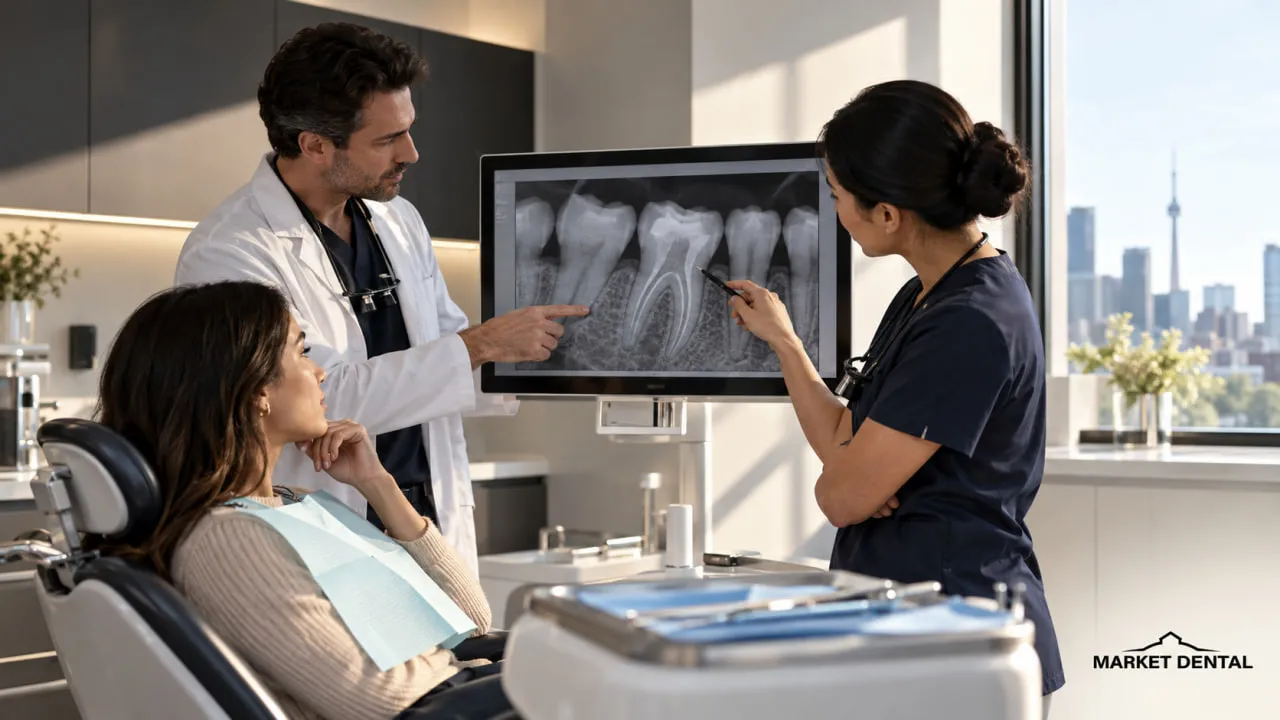
If you have just heard "this tooth probably needs a root canal," the endodontist vs dentist root canal question usually comes next. Should your regular dentist treat it, or would a specialist make more sense? Both paths are a normal part of dental care. Many root canals are completed by general dentists, while others are referred because something about the tooth adds difficulty. The right choice depends on the tooth itself: the diagnosis, canal anatomy, previous treatment, and how much healthy structure remains. Both options can be appropriate, and referral is often simply part of coordinated dental care for patients.
Endodontist vs Dentist Root Canal: The Short Answer
General dentists are trained to perform root canal treatment. Endodontists complete additional accredited specialty education focused on endodontics.
The Canadian Dental Association and Canadian Academy of Endodontics state in guidance on root canal treatment in Canada that dentists routinely perform root canals, while an endodontist may be recommended for more complex cases.
Referral becomes more relevant when:
- canal anatomy looks difficult;
- an earlier root canal needs retreatment;
- the diagnosis is uncertain;
- trauma or a crack complicates the case;
- endodontic surgery may be considered.
What Is the Difference Between an Endodontist and a General Dentist?
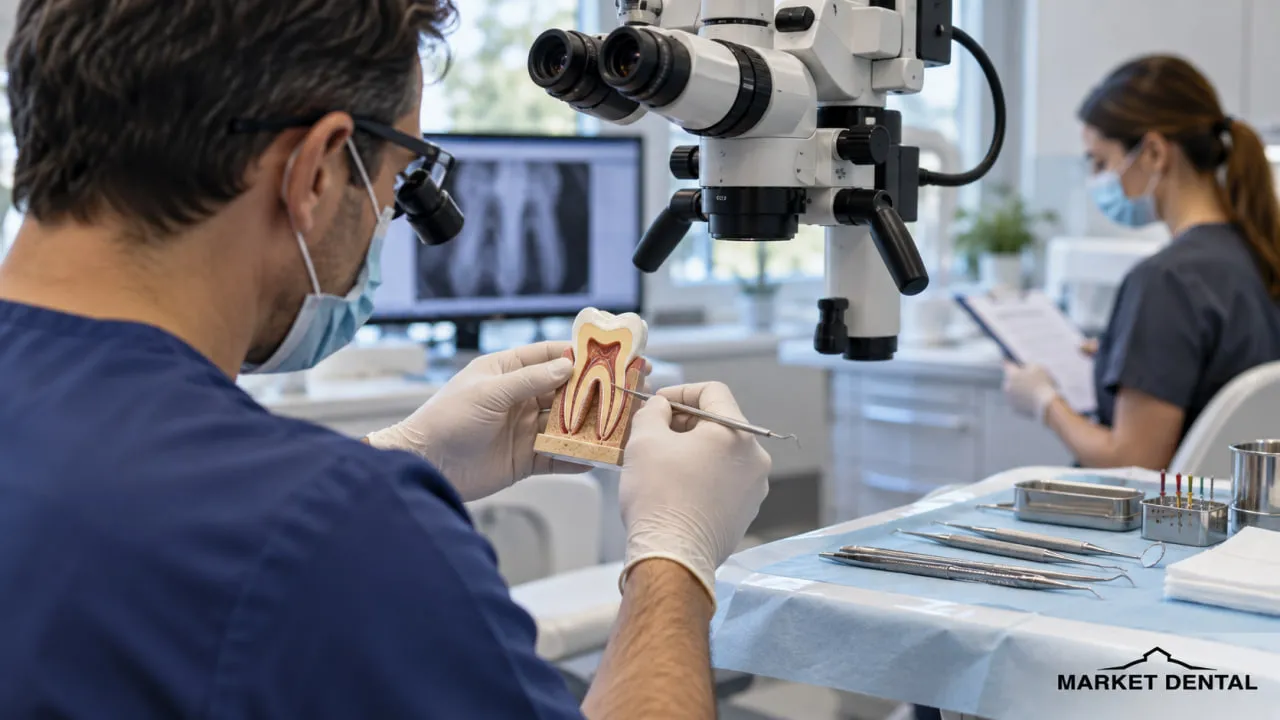
A general dentist has a broad scope of dental practice. Depending on the case, the same dentist may diagnose, treat, restore, and continue to monitor the tooth.
An endodontist is a dentist who has completed additional accredited postgraduate specialty education focused on the dental pulp and tissues around the roots. In Ontario, endodontics is a recognized specialty, and only dentists with specialist registration may present themselves as endodontists.
The distinction is about training focus and case selection, not quality.
When May a General Dentist Be a Good Fit for Root Canal Treatment?
Tooth type alone is a poor guide. A front tooth can be complex, while a molar may fall within an experienced general dentist's scope.
A general dentist root canal may be a reasonable fit when:
- the diagnosis is clear;
- the canals appear manageable on the available imaging;
- the tooth is being treated for the first time;
- major calcification or obstruction is not evident;
- restorability has been assessed;
- the dentist is comfortable treating that tooth with the available clinical support.
A molar with accessible canals may remain in general practice, while a front tooth whose canal narrowed after an old injury may be referred. In an endodontist vs dentist root canal decision, the choice is made tooth by tooth.
When a dentist refers a case beyond their preferred scope, that is ordinary coordinated care. Market Dental Centre's root canal treatment page explains the procedure itself.
When Does a Referral to an Endodontist Make Sense?
Four situations commonly shift an endodontist vs dentist root canal decision toward referral.
Curved, Narrow, Calcified, or Unusual Canal Anatomy
Canals that curve sharply, narrow, calcify, or branch unexpectedly can be harder to treat. Tooth type alone does not decide the referral.
Root Canal Retreatment
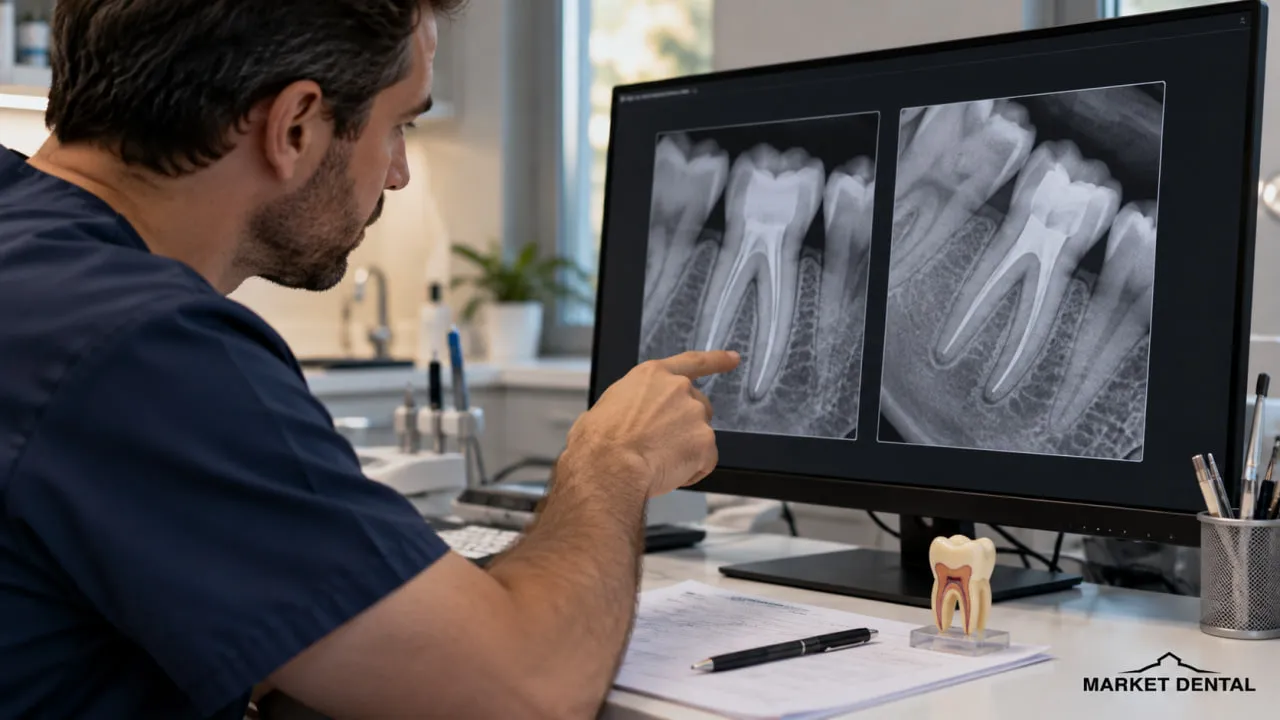
A previously treated tooth sometimes needs treatment again because disease persisted or returned. Retreatment may involve earlier filling materials, posts, missed or hard-to-reach canals, or altered anatomy. It is a common reason for referral, although each case is judged individually.
Dental Trauma, Cracks, or an Uncertain Diagnosis

An injury, hard-to-localize pain, a possible crack, or unusual symptoms can add diagnostic complexity. Not every cracked or injured tooth needs specialist treatment.
Endodontic Surgery
Occasionally a problem around a root tip persists after treatment. In selected cases, an endodontist may assess whether endodontic surgery, such as an apicoectomy, is appropriate.
General Dentist vs Endodontist for Root Canal Care
This endodontist vs dentist root canal comparison looks at roles, not quality.
Some general dental offices also have advanced imaging or magnification. Neither a microscope nor CBCT should be treated as a universal dividing line between general dentists and endodontists.
What Happens If Your Dentist Refers You to an Endodontist?

If a referral has you searching for a root canal specialist in Toronto, the process often looks like this, although offices differ:
- Your general dentist assesses the tooth and explains the reason for referral.
- Relevant records and radiographs may be shared.
- The endodontist evaluates and, when appropriate, treats the endodontic problem.
- Findings may be communicated back to the referring dentist.
- Restorative care is completed as appropriate.
Many patients return to their general dentist for the final restoration, which may or may not be a crown. Market Dental Centre's root canal recovery guide covers what may happen after treatment and before restorative care is complete.
Questions to Ask Before You Decide Who Should Treat the Tooth
Whichever way an endodontist vs dentist root canal decision goes, these questions can make the recommendation easier to understand:
- What makes this root canal straightforward or complex?
- Does the imaging suggest curved, narrow, calcified, or unusual canals?
- Is this a first treatment or a retreatment?
- Would you treat this tooth yourself or recommend referral?
- Would additional imaging or magnification change the plan?
- Who will handle the final restoration?
- What should I check about fees and coverage before treatment?
The goal is to understand why a particular provider is being recommended.
Does Seeing an Endodontist Change the Cost or Insurance Process?

It can. Dental fees vary, and the Ontario Dental Association Suggested Fee Guide is a reference dentists are not required to follow. Specialist fees may differ depending on the procedure and the practice.
Private coverage also varies by plan. Your portion can depend on deductibles, co-insurance, annual maximums, recognized fees, and specialist-service rules.
A predetermination may help estimate reimbursement, but it does not guarantee payment. Market Dental Centre provides insurance claim support, and its dental insurance information page lists useful questions for your insurer.
Under the Canadian Dental Care Plan Dental Benefits Guide effective April 1, 2026, standard root canal treatment on anterior teeth, bicuspids, and first and second molars generally does not require preauthorization when program criteria are met. Retreatment, apicoectomy, retrofilling, and standard root canal treatment on third molars require preauthorization. Coverage also depends on tooth eligibility, restorability, program limits, and active coverage.
What If the Tooth Hurts While You Are Waiting for a Referral?
Appointment availability varies, so do not simply wait if symptoms change. Contact the referring dental office if:
- pain becomes significantly worse;
- swelling develops or increases;
- fever or significant illness appears;
- a temporary restoration changes or comes out;
- another new symptom develops.
Difficulty breathing or swallowing, or rapidly spreading facial or neck swelling, requires emergency medical assessment. For other urgent dental concerns, Market Dental Centre's emergency dental care page explains how to contact the clinic and what symptoms to mention.
Nervous About a Root Canal? Provider Choice Is Only One Part of the Plan
Local anesthesia reduces pain sensation in the treatment area. Sedation is different: it may be considered to reduce anxiety or awareness depending on your health, the procedure, the provider, the facility, and the clinical plan.
Do not assume that choosing a general dentist or an endodontist automatically determines which comfort options are available. Market Dental Centre's guide to dental anxiety and sedation options explains the distinction and the questions worth asking before treatment.
How Market Dental Centre Helps You Decide
Market Dental Centre is a general dental practice at 149 Lower Jarvis Street in Downtown Toronto, near St. Lawrence Market.
An examination can help determine what the tooth needs and whether general-practice treatment or specialist assessment is appropriate. The recommendation should come from the tooth's clinical findings rather than a blanket rule.
Key Takeaways
- General dentists and endodontists can both be involved in root canal care.
- Endodontists have additional accredited specialty education in endodontics.
- In an endodontist vs dentist root canal decision, complexity matters more than a universal rule.
- Canal anatomy, retreatment, trauma, and diagnostic uncertainty can affect referral.
- Technology varies between practices.
- Referral is part of coordinated care, not evidence that general dental treatment is inferior.
- Fees and coverage vary by provider, procedure, and dental plan.
- Worsening symptoms should be reassessed rather than ignored.
This article provides general information and cannot determine who should treat a particular tooth. A dentist needs to examine the tooth and relevant dental records before recommending treatment or referral.
Not Sure Who Should Treat Your Root Canal in Downtown Toronto?
You do not need to settle the endodontist vs dentist root canal question with an online checklist. An examination can help clarify whether root canal treatment is appropriate, how complex the tooth appears, whether more diagnostic information may be useful, and whether general-practice treatment or specialist assessment makes sense.
Market Dental Centre is located at 149 Lower Jarvis Street in Downtown Toronto, near St. Lawrence Market.
Call (416) 363-4115 or request an appointment to discuss the next appropriate step.