










Dental crown vs onlay becomes a real question when a tooth needs more support than a routine filling but may still have healthy structure worth keeping. Add an inlay to the conversation and the names can blur together quickly. The useful difference is not which restoration sounds stronger. It is how much of the tooth is damaged, whether one or more cusps need protection, and how much sound enamel and dentin can remain. A smaller restoration is not automatically better, and a full crown is not automatically excessive. The right amount of coverage should match the tooth. This guide explains how dentists make that decision and what Toronto patients may want to ask before treatment.
Start With the Tooth, Not the Restoration Name
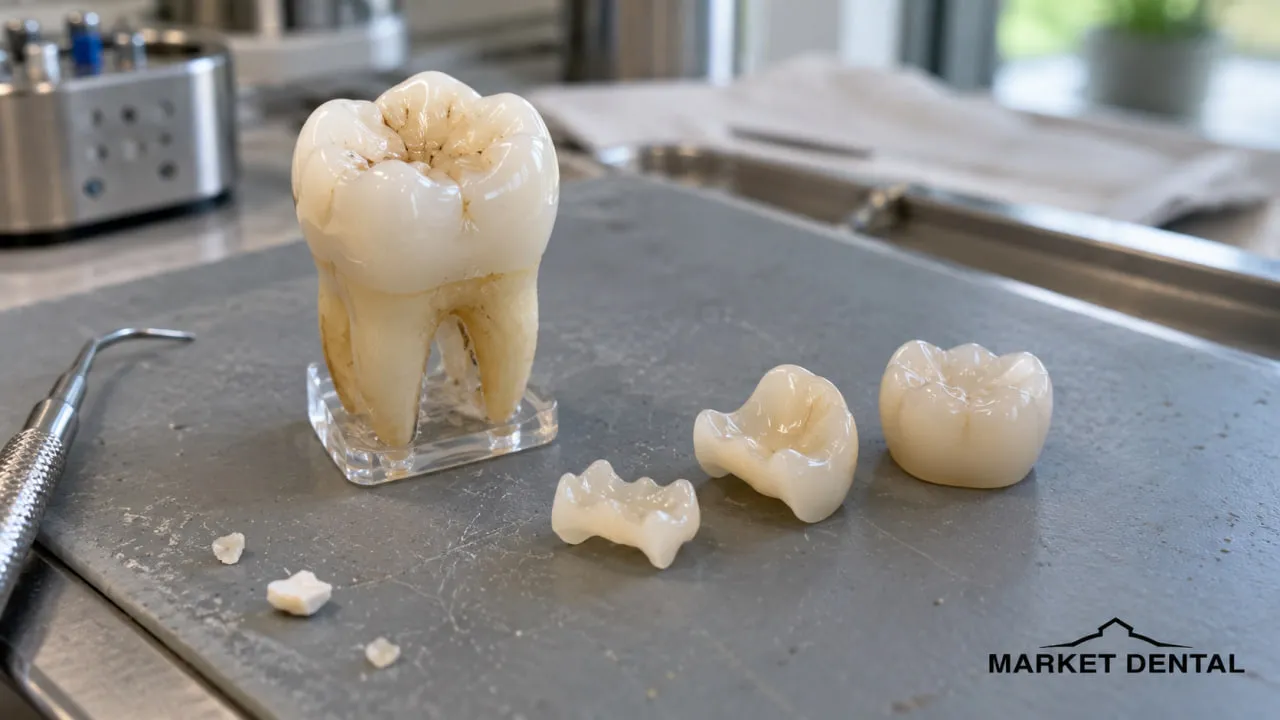
Back teeth have raised biting points called cusps. Restorations differ mainly in how much of that structure they cover.
Filling → Inlay → Onlay → Crown
- Filling: repairs a limited area directly in the mouth.
- Inlay: sits within the cusps without covering them.
- Onlay: extends over one or more weakened cusps.
- Crown: provides full coverage around the visible part of the tooth.
That sequence is useful, but it is not a fixed ladder. A small cavity may never need more than a dental filling. A badly fractured tooth may need full coverage because partial coverage would not provide enough support.
The central dental crown vs onlay question is therefore not “Which is more modern?” It is “How much coverage does this tooth actually need?”
Why Cusps Change the Recommendation
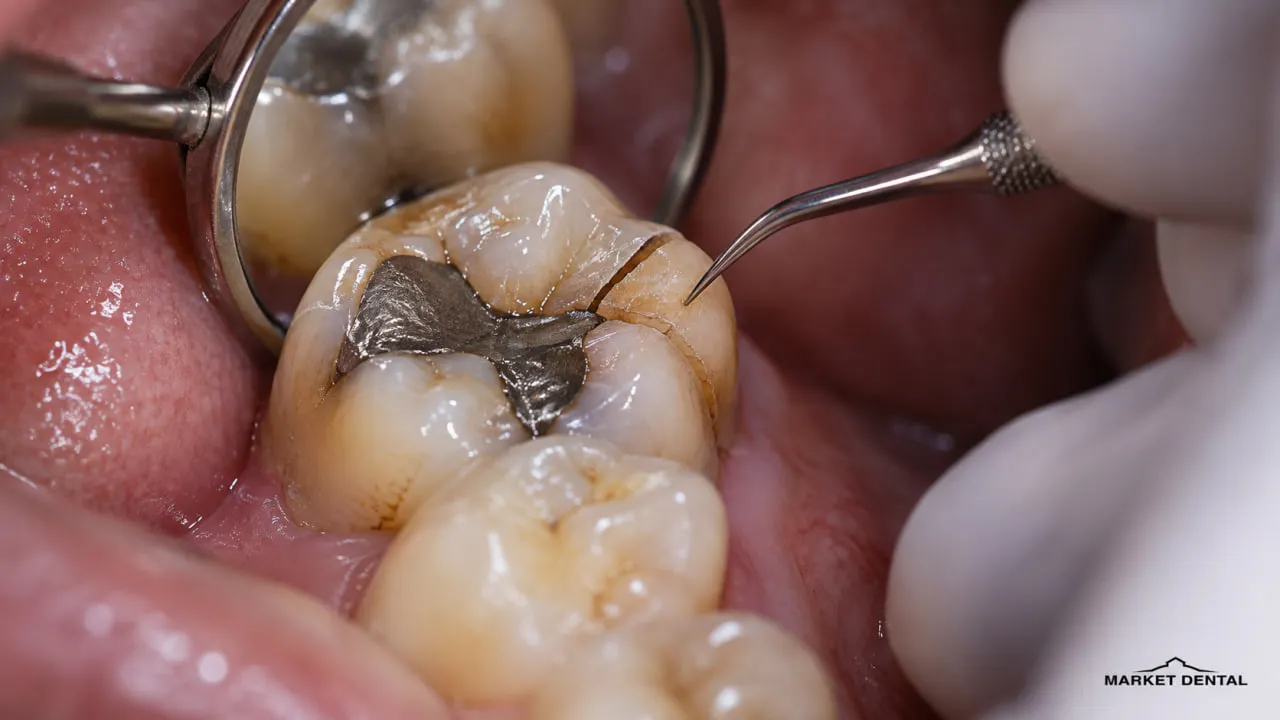
Cusps take much of the load when molars and premolars meet during chewing. A large filling can leave a cusp thin or undermined even when the outside of the tooth still looks intact.
If the cusps remain strong, a filling or inlay may be enough. If one or more cusps are vulnerable, an onlay can cover those areas. When very little sound tooth remains, or damage extends around much of the tooth, a crown may be more appropriate.
Cracks make the decision less predictable. A crack limited to one cusp is different from a deeper crack extending toward the root. Location, depth, symptoms, bite forces, and remaining structure all matter.
That is why percentage rules such as “40% tooth loss means an onlay” are not reliable for patients to use at home.
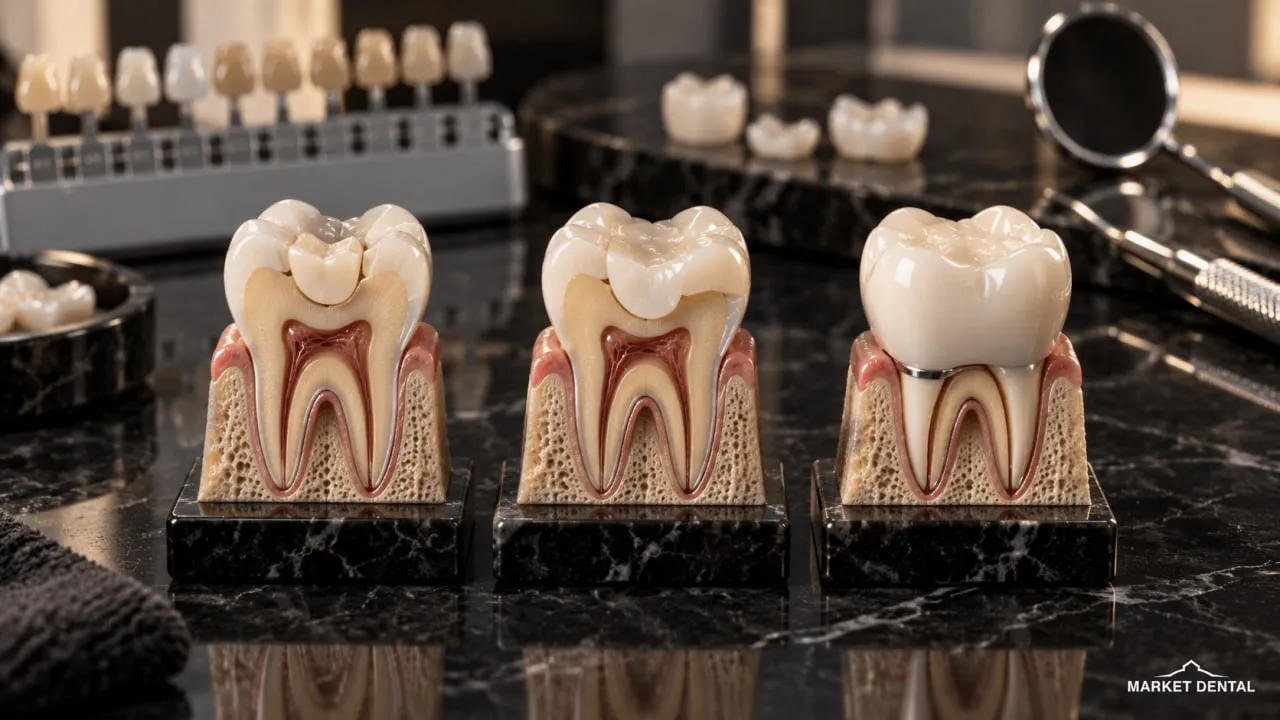
Dental Crown vs Onlay vs Inlay: A Practical Comparison
A 2022 systematic review found no significant difference in short-term survival between tooth-colored onlays or partial crowns and full crowns at one and three years. The authors also noted that stronger long-term evidence is still needed. Read the systematic review
That supports a case-by-case treatment decision rather than assuming full coverage always lasts longer.
When an Inlay May Be Enough
An inlay occupies the space between the cusps. It may be considered when a defect is too large or unsuitable for a routine direct filling, yet the surrounding cusps remain strong.
Imagine an old filling in the center of a molar. Once the filling and decay are removed, the cusps are still intact and well supported. The dentist may consider another direct restoration or an inlay depending on the size, bite, material, and remaining tooth.
An inlay does not protect a weak cusp. If preparation reveals a fracture or a cusp that is structurally compromised, extending the restoration over that cusp may make more sense.
It is also too broad to say an inlay is always stronger or better sealed than a composite filling. Material, preparation design, bonding, moisture control, and cavity size all affect performance.
When an Onlay May Preserve Useful Tooth Structure

An onlay can replace a large damaged area and cover selected cusps without wrapping around the entire tooth.
This is where dental crown vs onlay becomes especially relevant. If the tooth has healthy walls and suitable bonding surfaces, partial coverage may reinforce the weak part while avoiding preparation of areas that do not need coverage.
An onlay may be discussed when there is:
- a large existing filling with a weakened or fractured cusp
- a crack pattern that may be contained with selected cusp coverage
- substantial damage but enough sound structure for a bonded partial restoration
- a root-canal-treated tooth with adequate remaining structure, depending on tooth type and loading
None of these findings guarantees an onlay. Margin location, isolation, bite forces, crack pattern, and the amount of enamel and dentin remaining can change the recommendation.
When a Full Crown Becomes More Appropriate
A crown covers the tooth around its circumference. It may be considered when too little sound structure remains for a partial restoration, several walls or cusps are badly compromised, a previous crown needs replacement, or the fracture pattern calls for broader coverage.
Root canal treatment does not mean every tooth automatically needs the same restoration. Back teeth often need cusp protection because of their function and the structure already lost, but the choice between an onlay and crown still depends on what remains.
For someone comparing dental crown vs onlay after a root canal, the useful question is: how much sound tooth is left, and what level of coverage will protect it under the bite?
Market Dental Centre also provides information about root canal therapy for patients trying to understand what may happen before a final restoration is selected.
Conservative Dentistry Means Enough Treatment, Not the Smallest Treatment
Preserving healthy tooth structure matters. Enamel and dentin that do not need to be removed are worth keeping.
But the smallest restoration is not always the most conservative long-term choice. An onlay that cannot adequately protect a badly compromised tooth may fail for reasons a crown would have addressed.
The aim is to remove no more tooth than necessary while still providing enough coverage for the clinical situation. That is also why claims such as “crowns remove 60% to 75% of the tooth” or “onlays preserve 80% of enamel” should not be treated as universal rules. Preparation varies with the tooth, material, existing damage, and restoration design.
A better dental crown vs onlay comparison asks which areas are healthy enough to preserve and which areas need reinforcement.
Material Choice Comes After Coverage
Once the dentist decides how much of the tooth needs restoration, material selection follows.
Lithium disilicate is a glass ceramic used for many bonded restorations. It can provide tooth-like color and works well in suitable designs.
Zirconia is another ceramic used widely for crowns and in selected partial restorations. Different zirconia formulations vary in translucency and strength.
Indirect composite may be used for selected inlays or onlays. It can be repaired intraorally, while wear and discoloration depend on the material and case.
Gold alloy remains an option for selected back teeth. It has a long clinical history and can function in relatively thin sections, but its metallic appearance is not acceptable to everyone.
No material is “best” in isolation. Tooth position, restoration thickness, bite, appearance goals, and bonding conditions all influence the choice.
What Happens During Treatment?

A dental crown procedure in Downtown Toronto and an indirect inlay or onlay procedure share several steps, but the workflow varies by case.
- Assessment: the dentist examines the tooth, reviews symptoms and existing dental work, evaluates the bite, and uses imaging when clinically indicated.
- Removal of decay or failing material: once an old filling or decay is removed, the true amount of sound tooth becomes clearer. Sometimes the planned restoration changes at this stage.
- Preparation: the dentist shapes the tooth for the selected restoration and material.
- Impression or scan: some offices use conventional impression material; others use digital scanning.
- Fabrication: the restoration may be made by a dental laboratory or, in some practices, with an in-office milling system.
- Placement: fit, contact with neighboring teeth, and bite are checked before the restoration is bonded or cemented.
Local anesthetic is commonly used when needed for comfort. If the bite feels clearly high after numbness wears off, contact the dental office rather than waiting for the tooth to “get used to it.”
Cost and Insurance in Ontario: Compare the Treatment Plan, Not a Generic Price

Tooth restoration cost in Ontario varies because an inlay, onlay, or crown is not one standardized product.
Fees may change with:
- restoration type and material
- tooth position and complexity
- laboratory costs where applicable
- additional buildup or restorative work
- whether another treatment is needed first
- the dentist's individual fee
The Ontario Dental Association publishes a Suggested Fee Guide as a reference for dentists. It is not a mandatory price list, and dentists set their own fees.
Insurance is plan-specific. A private plan may classify crowns, inlays, and onlays differently, apply frequency or replacement limits, reimburse an alternate benefit, or require supporting information. Deductibles, co-insurance, annual maximums, and the insurer's recognized fee may also affect the patient portion.
A predetermination can help estimate expected benefits for planned treatment, but it does not guarantee final payment. Direct billing or claim submission also does not guarantee coverage.
Market Dental Centre's dental insurance information provides additional context on reviewing coverage before treatment.
Three Borderline Cases Show Why the Answer Changes
A Large Filling, Strong Cusps
An old filling needs replacement, but after it is removed the surrounding cusps are still thick and intact.
A direct filling or inlay may remain reasonable. Full coverage solely because the previous filling was large may be more treatment than the tooth needs.
One Cusp Has Cracked
Another molar has a large restoration and one cusp has fractured, while the remaining walls are healthy.
An onlay may enter the discussion because it can replace the damaged area and cover the compromised cusp. A crown may still be chosen if the crack pattern, bite, or remaining structure makes partial coverage less predictable.
Very Little Tooth Remains
A third tooth has repeated large restorations, multiple weakened walls, and little sound structure above the gumline.
Here, a crown or another restorative plan may be more appropriate. “Preserve enamel” is less useful advice when there is very little healthy enamel left to preserve.
These examples are hypothetical. They show why dental crown vs onlay is a structural decision rather than a simple preference.
Comparing Restorative Options in Downtown Toronto
Market Dental Centre provides general and restorative dental care at 149 Lower Jarvis Street in Downtown Toronto, Ontario, near St. Lawrence Market. Its current service information includes dental fillings and crowns among restorative care options.
If a tooth needs more than a filling, a general dentist can examine it, review appropriate imaging, and explain which restoration designs may be reasonable based on the remaining structure. If you specifically want to discuss an inlay or onlay, ask whether that option is appropriate and available for your case.
Toronto patients researching crown fees can also review Market Dental Centre's dental crown cost guide to understand the factors behind an estimate without treating an online figure as an individual quote.
Key Takeaways
- Dental crown vs onlay is mainly a question of how much of the tooth needs coverage.
- An inlay stays within the cusps; an onlay covers selected cusps; a crown provides full coverage.
- Preserving natural tooth structure matters, but the smallest restoration is not always the most conservative long-term choice.
- Fixed percentages of tooth loss or enamel saved should not be used as self-diagnosis rules.
- Root canal treatment does not automatically dictate one restoration for every tooth.
- Material choice comes after the dentist decides how much coverage is needed.
- Insurance and fees vary by plan and treatment details; predetermination is not a payment guarantee.
- A borderline case should come with a clear explanation of why partial or full coverage is being recommended.
Not Sure How Much of the Tooth Really Needs to Be Covered?
You do not need to choose dental crown vs onlay from a photo, a price list, or someone else's treatment experience. The useful question is how much healthy structure remains after decay, old restorative material, and cracks are accounted for.
Market Dental Centre is located at 149 Lower Jarvis Street in Toronto, Ontario. A general dentist can assess the tooth and explain why a filling, partial-coverage restoration, crown, or another option may fit the clinical findings.
Call (416) 363-4115 or contact Market Dental Centre to discuss a damaged tooth or an existing treatment recommendation.

.webp)


