








The root canal recovery timeline is easier to understand when you separate three things: the numbness after treatment, the soreness that may follow, and the time your tooth still needs protection before its final restoration is complete. You may leave the dental chair feeling fine because the anesthetic is still working, then wonder a few hours later whether it is safe to eat or why the tooth feels tender when you bite. The answer depends less on a rigid day-by-day schedule and more on sensation, chewing pressure, and the restoration currently protecting the tooth. Those three factors should guide what you eat and when you return to normal chewing.
Root Canal Recovery Timeline: Three Different Clocks Are Running

A single recovery date does not tell the whole story. Root canal treatment addresses inflamed or infected pulp tissue inside the tooth, but different parts of recovery move at different speeds.
Clock 1: Numbness and Eating Safety
Local anesthetic can continue affecting the lips, cheek and tongue after the procedure.
While an area remains numb, chewing creates an avoidable risk of biting soft tissue without realizing it. Very hot food or drinks are also harder to judge accurately when sensation is reduced.
Wait until normal feeling has returned before chewing. If you received sedation or your treating dentist gave additional instructions, follow those directions instead of general online advice.
Clock 2: Comfort Recovery
After the anesthetic wears off, the treated tooth may feel tender under pressure. Some people also notice mild jaw soreness after keeping their mouth open during treatment.
For many patients, this improves over the following several days. The direction matters more than an exact deadline: soreness that is gradually settling is different from pain that becomes stronger or new swelling that appears.
Clock 3: Protecting the Tooth Until It Is Fully Restored
This clock may continue after the tooth feels comfortable.
Depending on the treatment plan, the tooth may currently have:
- a temporary filling
- another provisional restoration
- a permanent bonded restoration
- or a planned crown or partial-coverage restoration
The amount of chewing pressure the tooth can safely handle depends partly on what is protecting it.
Tissues around the root may also continue healing after symptoms improve. So the root canal recovery timeline for comfort and the timeline for structural protection are not identical.
When Can You Eat After a Root Canal?
The simplest rule is to avoid chewing until normal sensation has returned.
That reduces the chance of accidentally biting your cheek, lip or tongue. It also makes it easier to judge food temperature.
Once sensation is back, eating can usually restart according to comfort and your dentist's instructions. If the treated tooth has a temporary restoration, keep heavier chewing away from that side.
There is no need to treat a routine root canal like an extraction. A root canal does not leave an open tooth socket with a blood clot that needs to be protected.
What to Eat After a Root Canal: Think About Chewing Effort, Not the Calendar

Instead of following a strict Day 1, Day 2 or Day 5 food plan, choose food according to how much pressure it requires.
That makes the root canal recovery timeline more practical because the same food may be comfortable for one person sooner than another.
Low-Chew Foods
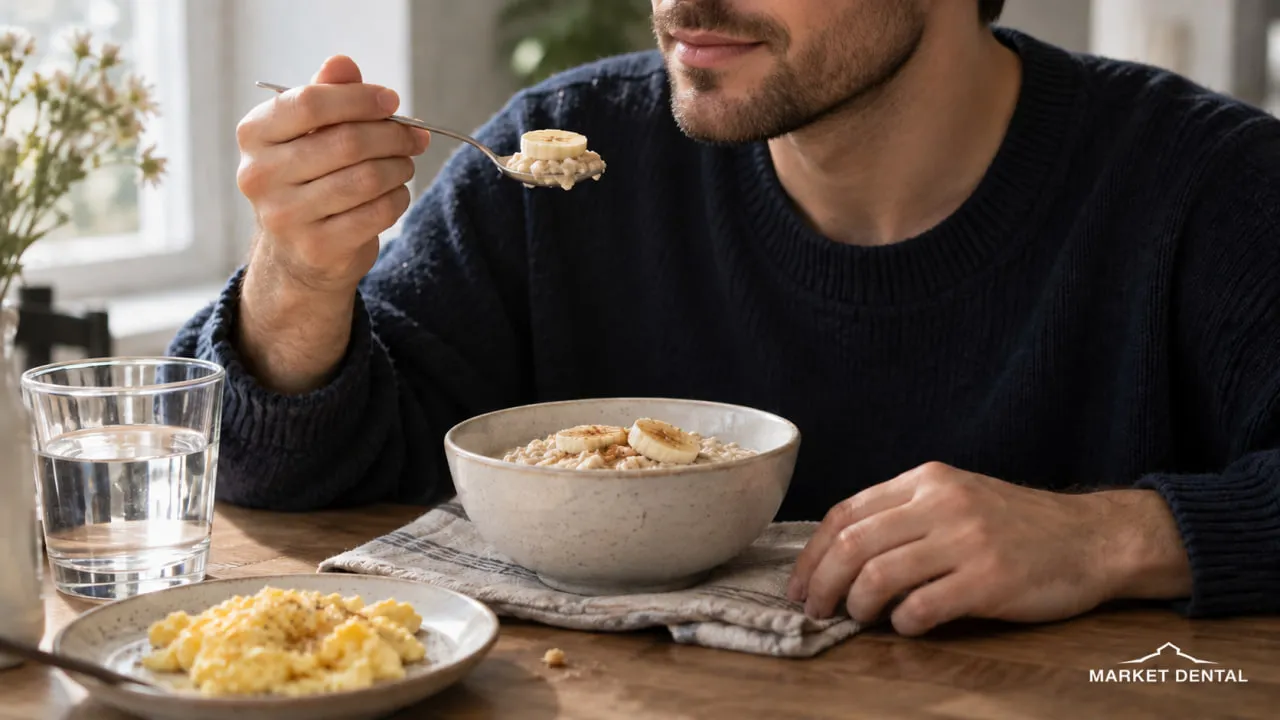
These require very little bite force:
- yogurt
- applesauce
- oatmeal
- mashed potatoes
- scrambled eggs
- soft tofu
- smooth or soft soups
- cottage cheese
- ripe banana
These are useful when the tooth still feels tender after numbness has worn off.
Foods That Need Light Chewing
As comfort improves, options may include:
- soft pasta
- flaky fish
- well-cooked vegetables
- tender lentils
- soft rice
- avocado
- soft cooked grains
Chew mainly away from the treated tooth when a temporary restoration is still present.
Firmer Foods
Foods such as raw carrots, crusty bread, nuts and firmer meats require considerably more bite force.
Reintroducing them depends on comfort and, more importantly, the restoration protecting the tooth. A tooth that feels painless may still need to avoid heavy chewing until definitive restorative treatment is complete.
Eating After a Root Canal With a Temporary Filling Takes Extra Care

A temporary filling closes the access opening while the tooth awaits the next stage of care. It is intended for temporary protection rather than long-term heavy chewing.
Until your dentist says otherwise, avoid putting substantial pressure directly on that tooth.
Be especially cautious with:
- ice
- hard candy
- nuts
- popcorn kernels
- caramel
- taffy
- chewing gum
- very tough meat
A small amount of superficial wear on some temporary materials can occur. If the filling feels loose, a significant piece has been lost, or the opening no longer feels sealed, contact the dental office.
That does not automatically mean the root canal has failed. It means the temporary restoration should be checked.
Do not try to repair it with household glue or another non-dental product.
The Foods Most Likely to Cause Problems Have One Thing in Common: Force
A long list of banned foods is less useful than understanding what they do mechanically.
Hard and Brittle Foods
Ice, hard candy, hard nuts and very firm crusts concentrate force on a small area.
That is particularly unhelpful when a back tooth has already lost substantial structure or still has a temporary restoration.
Sticky Foods
Caramel, taffy and chewing gum can pull on temporary restorative material as your teeth separate.
Tough Foods
Jerky, dense breads and tough meat require repeated chewing. They may be uncomfortable even if they do not directly damage the restoration.
Very Hot Foods While You Are Numb
This is mainly a soft-tissue safety problem. Reduced sensation makes it easier to burn the lips, cheek or tongue without realizing how hot something is.
There is no universal reason to eliminate spicy foods, citrus or carbonated drinks after every root canal. If something irritates a tender area, avoid it temporarily and return to it when comfortable.
Straws and Dry Socket Rules Belong to Extraction Recovery, Not Routine Root Canal Care
This is one place where dental aftercare advice often gets mixed together.
After an extraction, the body forms a blood clot inside the socket, so suction and other factors can matter. A routine root canal does not remove the tooth and does not create that socket.
That means there is no standard 48-hour straw ban simply because you had a root canal.
Market Dental Centre's guide to what to eat after tooth extraction covers those different precautions.
For routine root canal aftercare:
- continue brushing gently
- clean between the teeth according to your dentist's instructions
- do not aggressively manipulate a temporary restoration
- use any rinse only as instructed
A mild warm saltwater rinse may feel soothing if nearby gum tissue is irritated, but it does not treat or clean the root canals themselves.
Feeling Better Does Not Mean the Tooth Is Ready for Heavy Chewing

This is one of the most important differences between comfort recovery and structural recovery.
A root-canal-treated tooth does not become vulnerable simply because the pulp and its blood supply were removed and the tooth somehow “dried out.” That explanation oversimplifies what happens.
The tooth may already have lost substantial structure because of:
- deep decay
- a large previous filling
- a crack or fracture
- the damage that led to root canal treatment
- the access opening required to treat the canals
How much sound tooth remains matters greatly when deciding how it should be restored.
So when the soreness disappears, do not use pain alone as permission to test the tooth with hard food. The structural part of the root canal recovery timeline continues until the recommended final restoration is completed and your dentist confirms how the tooth should be used.
The Final Restoration Is Based on the Tooth, Not Simply the Root Canal

Not every root-canal-treated tooth requires exactly the same final restoration.
A Bonded Filling May Be Appropriate
Selected teeth with substantial remaining structure may be restored with a permanent bonded filling.
Some Teeth Need Cuspal Coverage
Back teeth that have lost significant supporting structure often need a restoration that protects one or more cusps from chewing forces.
An Onlay or Crown May Be Considered
The amount of remaining structure, existing cracks, tooth position and bite help determine how much coverage is appropriate.
Market Dental Centre's guide to dental crowns, onlays and inlays explains this decision in more detail.
There is no universal “crown at two to four weeks” rule. Follow the timing recommended for your individual treatment plan and avoid unnecessarily delaying a definitive restoration.
What Usually Fits Recovery, and What Deserves a Call?
| Often Fits Early Recovery | Contact the Dental Office |
|---|---|
| Mild tenderness when biting | Severe pain or pressure that lasts more than a few days |
| Soreness that gradually decreases | Pain that is becoming stronger rather than improving |
| Mild jaw stiffness | Visible swelling inside or outside the mouth |
| Tooth feeling different under pressure | Bite feels clearly uneven after numbness is gone |
| Minor superficial wear of temporary material | Temporary filling or crown comes out or feels loose |
| Mild tenderness near the injection or isolation area | Symptoms from before treatment return |
The American Association of Endodontists provides similar post-treatment guidance and advises patients to contact their dentist or endodontist for severe persistent pain or pressure, visible swelling, an uneven bite, loss of a temporary restoration or a return of previous symptoms.
If your tooth seems to contact before the surrounding teeth once the anesthetic is completely gone, call the dental office. A bite adjustment may be appropriate after the tooth is checked.
Rapidly spreading facial or neck swelling, trouble breathing or swallowing, or significant systemic illness with swelling requires urgent medical attention.
Root Canal Treatment and the Final Restoration May Have Different Insurance Benefits
Private dental insurance in Ontario varies by plan.
Root canal treatment and the restoration placed afterward use different dental procedure codes, so coverage for one does not automatically tell you what the plan will pay for the other.
Your portion can depend on:
- deductible
- co-insurance
- annual maximum
- procedure category
- insurer-recognized fee
- replacement or frequency rules
- remaining benefits
A predetermination may help estimate expected benefits for planned restorative treatment, but it is not a guarantee of final payment. Direct billing also does not guarantee coverage.
For a deeper financial explanation, see Market Dental Centre's guide to root canal cost in Toronto.
Root Canal Recovery in Downtown Toronto: When Follow-Up Makes Sense
If you are several days into recovery and the tooth is becoming more comfortable, that usually tells a different story from increasing pain, new swelling or a temporary restoration that has come loose.
For patients in Toronto, the useful details to report when calling are:
- when the root canal was completed
- whether discomfort is improving or worsening
- whether swelling is present
- whether the bite feels high
- whether the temporary restoration is still intact
Market Dental Centre provides root canal therapy at 149 Lower Jarvis Street in Downtown Toronto, Ontario, near St. Lawrence Market.
The important distinction is simple: feeling better can mark progress in the comfort portion of the root canal recovery timeline, while the tooth may still need its restorative treatment completed before heavy chewing resumes.
Key Takeaways
- Root canal recovery involves separate timelines for numbness, comfort and structural protection.
- Wait until normal sensation has returned before chewing.
- Choose food by chewing demand rather than following a rigid day-by-day diet.
- Hard, sticky and very tough foods deserve extra caution when a temporary restoration is present.
- A routine root canal does not require extraction-style dry socket precautions or a standard straw ban.
- A tooth can feel comfortable before it is ready for heavy chewing.
- Not every root-canal-treated tooth requires the same final restoration.
- Increasing pain, swelling, an uneven bite or a lost temporary restoration should be discussed with the dental office.
For urgent dental symptoms that do not meet those medical-emergency criteria, Market Dental Centre's emergency dental care information explains appropriate next steps.
Recovery Not Moving in the Right Direction?
If discomfort is increasing instead of settling, your bite feels uneven, swelling has developed, a temporary restoration has come out, or the final restoration still needs to be completed, contact the dental office rather than testing the tooth with heavier chewing.
Market Dental Centre is located at 149 Lower Jarvis Street in Downtown Toronto, Ontario, near St. Lawrence Market.
Call (416) 363-4115 or request an appointment online and explain where you are in the recovery process.

.webp)


