










If you searched for a dentist without insurance Canada, the short answer is yes: you can generally book dental care without private coverage and pay the clinic directly. Many people in Ontario assume OHIP pays for routine dental treatment or that insurance is required before a dentist will see them. In most cases, neither is true. What matters is understanding the likely cost before treatment begins and checking whether you qualify for support such as the Canadian Dental Care Plan or an Ontario dental program. This guide explains common out-of-pocket dental costs in Toronto, how provincial fee guides work, which government programs may help, and what to ask a dental office before you book.
Dentist Without Insurance Canada: Can You Still Book an Appointment?
Yes. Private dental insurance is primarily a way of paying for eligible dental expenses. It is not a general prerequisite for seeking dental care.
Someone without employer benefits or an individual dental plan can still contact a dental office, arrange an appointment and pay directly for the services they receive. Some patients may also qualify for a federal, provincial or municipal dental program.
Individual dental offices have their own appointment and payment policies, so it is still sensible to ask how payment works before you book.
Need dental care but worried about the cost? Contact Market Dental Centre in Downtown Toronto to ask what type of appointment may be appropriate and what fees you should expect before you arrive.
How Paying for Dental Care Out of Pocket Usually Works
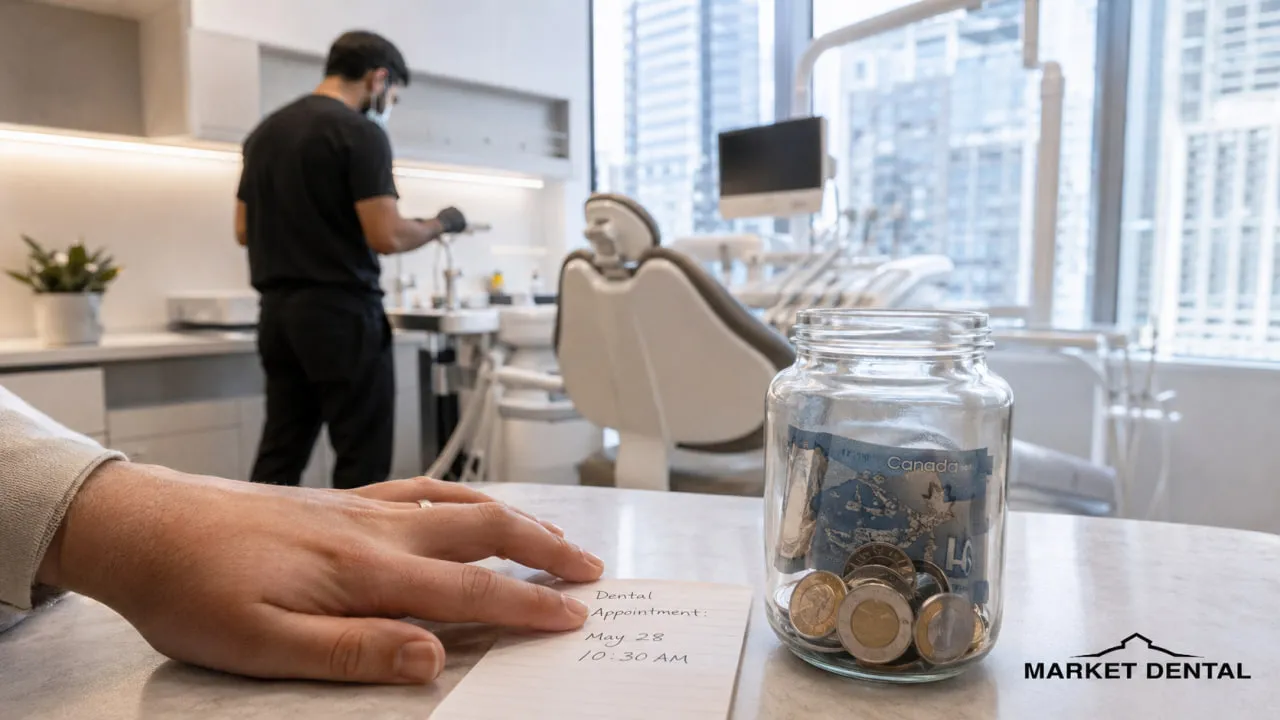
If you do not have private benefits, the process is usually straightforward:
- Contact the dental office and explain why you need an appointment.
- Ask about the initial appointment fee and whether services such as X-rays or cleaning are separate.
- Attend the examination so the dentist can assess your oral health or specific concern.
- Review the recommended treatment and estimated fees.
- Pay the clinic directly for services that are not covered by an eligible government program or another source.
If more than one treatment is recommended, ask which concern needs attention first and which treatment, if any, can reasonably wait.
Does OHIP Cover Dental Care in Ontario?
Not usually for routine dental care.
Ontario residents generally pay separately for dental examinations, professional cleanings, fillings and most other treatments performed in a regular dental office. OHIP may cover certain medically necessary dental surgery performed in a hospital under specific circumstances, but that is different from a routine visit to a dentist.
For most adults in Ontario, dental costs are handled through private benefits, government dental programs or direct payment.
That distinction catches a lot of people by surprise, especially if they have recently lost workplace benefits.
How Much Does a Dentist Visit Cost Without Insurance in Toronto and Ontario?

For someone searching for a dentist without insurance Canada, the next question is usually cost.
There is no single Toronto price for a check-up, filling or extraction. Dentists set their own fees, and the final amount depends on the service and the clinical findings.
The ranges below are general planning estimates for common dental services in Toronto and Ontario. They are not official ODA prices or a Market Dental Centre fee quote.
Actual costs may depend on:
- The type of examination
- The number and type of X-rays required
- The tooth being treated
- The number of surfaces involved in a filling
- How much scaling time is needed
- The complexity of an extraction
- Root anatomy and treatment complexity
- Additional procedures or materials
- The dental office's own fee schedule
A clinical examination is often necessary before a final diagnosis and meaningful treatment estimate can be provided.
Dental Exam Costs Without Insurance
Not every dental examination is the same.
A comprehensive examination is usually intended to assess your overall oral health and may be appropriate when you are new to a practice or have not had a full assessment for some time.
A recall examination is a periodic check for an existing patient.
A problem-focused or emergency examination is different again. It concentrates on a specific concern, such as tooth pain, swelling or a broken tooth.
If you call ahead, tell the office why you are booking. That makes it easier for staff to explain which appointment type may be relevant and what its basic fee is.
How Dental Cleaning Fees Work
The examination and the cleaning are normally separate services.
Scaling removes deposits from the teeth and is commonly measured in units of time. The amount required varies considerably. Someone with relatively little buildup may need less scaling than a person with heavier deposits or more complex periodontal needs.
Polishing, fluoride, examination fees and X-rays may also be separate.
If you are comparing dental costs in Toronto, ask for the individual components rather than assuming one advertised cleaning figure represents the entire appointment.
You can also learn more about dental cleaning at Market Dental Centre.
Filling, Extraction and Root Canal Costs
A filling is not priced solely by the fact that it is a filling. The tooth, material, number of surfaces and complexity can all influence the fee.
Extraction fees also vary. Removing a loose or easily accessible tooth is different from a more complicated surgical extraction.
Root canal treatment has its own variables, including the tooth involved and the number and complexity of its canals.
Most importantly, these treatments are not interchangeable simply because their prices differ. Your dentist first needs to determine what is happening clinically and discuss the reasonable treatment options.
Government Dental Assistance Programs for Uninsured Canadians

If paying the entire bill yourself is difficult, check whether you qualify for a public dental program before assuming that private insurance is your only option.
Eligibility rules differ, and having no insurance does not automatically qualify someone for every program.
Canadian Dental Care Plan
The Canadian Dental Care Plan, or CDCP, is a federal program for eligible Canadian residents who do not have access to private dental coverage.
Current eligibility requires all four of the following:
- No access to private dental insurance or coverage
- A Canadian tax return filed for the required year
- Adjusted family net income below $90,000
- Canadian residency for tax purposes
Access to private coverage can include an employer or pension plan, a family member's plan, an individual plan, certain student or professional organization benefits, and health spending accounts that cover dental expenses.
Current co-payments are based on adjusted family net income:
A 0% co-payment does not necessarily mean a $0 dental bill. A patient may still have to pay if the dental office charges more than the amount recognized by the CDCP, if a service is not covered, or if other plan limitations apply.
Review the Government of Canada's current CDCP eligibility requirements before applying or renewing.
Ontario Disability Support Program
Eligible Ontario Disability Support Program recipients have access to specified dental benefits.
Coverage is not identical for every family member. For example, dependent adults may fall under different benefit arrangements and may need to access discretionary dental assistance through Ontario Works.
Because eligibility and covered procedures can be specific, patients receiving ODSP should confirm their current dental benefits with their caseworker or program administrator before treatment.
Market Dental Centre also has a Canadian Dental Care Plan information page for patients who want to learn more about the program.
Ontario Works
In Toronto, adults receiving Ontario Works or Emergency Assistance may qualify for emergency dental benefits.
The program is primarily intended to help address urgent dental needs rather than function as comprehensive private dental insurance. Administration and discretionary benefits can also differ by municipality.
Children in eligible Ontario Works families may receive dental services through Healthy Smiles Ontario rather than the adult Ontario Works dental program.
Healthy Smiles Ontario
Healthy Smiles Ontario provides preventive, routine and emergency dental care for eligible children and youth aged 17 and under.
Eligibility depends on the program's rules. Some children are enrolled automatically because their family receives certain government assistance, while other families may need to qualify based on household income.
Covered care can include services such as check-ups, cleanings, fillings, X-rays and urgent dental treatment.
Ontario Seniors Dental Care Program
The Ontario Seniors Dental Care Program provides routine dental services for eligible low-income seniors.
Applicants must be at least 65, live in Ontario and meet current income and program eligibility requirements.
As of August 1, 2026, the annual net income limits are:
- $25,480 or less for a single senior
- $42,290 or less for a couple
Patients should check the current program rules before applying because income thresholds and administrative requirements can change.
How Dental Fees Are Calculated in Ontario
The Ontario Dental Association publishes an annual Suggested Fee Guide.
The word suggested matters.
The guide is not a government price list, and Ontario dentists are not required to charge its fees. Each practice sets its own fees, which may be above or below amounts in the guide.
Dental benefit providers may also refer to current or previous provincial fee guides when calculating reimbursement.
For someone paying directly, the most useful questions are often quite simple:
- What is the fee for the appointment I need?
- Does that fee include X-rays?
- Is a cleaning billed separately?
- If treatment is recommended, will I receive an estimate?
- Are there costs that cannot be confirmed until after an examination?
- Does the clinic currently work with any government program I may qualify for?
A treatment estimate is exactly that: an estimate. Fees can sometimes change if new clinical information becomes apparent while treatment is underway.
Smart Ways to Manage Dental Costs Without Insurance
Being uninsured does not make a dental bill disappear, but it does give you a reason to ask more questions before treatment starts.
That is not awkward. It is sensible.
1. Do Not Assume Preventive Care Is Unaffordable
If you have put off a check-up because you are worried about the bill, start by asking what the appointment actually costs.
Regular dental examinations and hygiene appointments allow a dental professional to look for changes before you are dealing with severe symptoms. Finding a cavity or gum problem earlier can sometimes mean that simpler treatment options are still available.
That does not mean every small cavity will become a root canal if you wait. Dental disease does not follow one fixed path.
The useful point is that earlier information gives you more opportunity to understand the problem and your choices.
2. Ask Which Treatment Is Most Important

If an examination identifies several needs, you do not have to guess where to begin.
Ask the dentist:
- Which issue is urgent?
- Which treatment should be completed soon?
- What can safely be monitored?
- Can clinically non-urgent treatment be completed in stages?
- What could happen if I wait on a particular procedure?
A phased plan can sometimes make costs easier to organize, but financial convenience should not override treatment that genuinely needs prompt attention.
3. Ask About Payment Arrangements Before Committing
Some dental offices and third-party financing providers offer ways to spread treatment costs over time. Policies and eligibility differ.
If instalments matter to you, ask before treatment begins rather than assuming a payment plan will be available.
For Market Dental Centre, current financing or payment-plan availability should be confirmed directly with the office before relying on it.
4. Check Whether Dental Expenses May Qualify for a Tax Credit
Some eligible dental expenses that you paid yourself and were not reimbursed may qualify for Canada's Medical Expense Tax Credit.
It is a non-refundable tax credit, not an immediate discount on your dental bill. The amount you may be able to claim depends on current CRA rules, your income, the eligible expenses and any reimbursement you received.
Keep your dental receipts and check the CRA's current medical-expense guidance when preparing your tax return.
5. Ask for a Written Estimate
A written treatment estimate is particularly useful if you do not have insurance.
It can show:
- The proposed services
- Individual fees
- Treatment stages
- Which procedures are clinically higher priority
- Which costs are expected now
- What could cause the estimate to change
An estimate cannot guarantee that the final amount will never change, but it gives you far more information than agreeing to treatment without discussing cost.
A Checklist Before Booking Dental Care Without Insurance
A short phone call can answer a surprising number of questions.
Before booking, consider asking:
- What type of appointment should I book for my concern?
- What is the fee for that appointment?
- Are X-rays charged separately?
- If I need a cleaning, is that a separate fee?
- Can I receive an estimate before further treatment?
- Does the clinic currently participate in the CDCP or another program I use?
- What payment methods are accepted?
- If several treatments are needed, can I discuss clinical priorities with the dentist?
If you are calling because of pain, swelling or an injury, say that at the beginning. The appropriate appointment may be different from a routine check-up.
For urgent concerns, you can review Market Dental Centre's emergency dental care information.
What Can Happen If You Postpone Dental Care?
Cost is a real reason people delay dental appointments. There is no benefit in making someone feel guilty about that.
At the same time, some untreated dental problems can become more complex. A small area of decay, for example, may eventually involve deeper parts of a tooth and require more involved care.
That does not happen in exactly the same way for every person.
The example below shows one hypothetical progression. It is not a prediction of what will happen to every untreated tooth.
A dental implant is not automatically required after every extraction, and root canal treatment is not the inevitable outcome of every cavity.
The practical reason to have a problem assessed is to find out what your tooth needs while you still have real information and choices.
A Toronto Example
Consider someone working in Downtown Toronto who loses their dental benefits after changing jobs.
They have been due for a check-up, but they assume a dentist will not see them without insurance. Months pass.
A more useful approach would be:
- Call a dental office and ask about the examination fee.
- Book as a self-paying patient.
- Get an assessment rather than guessing what treatment may be needed.
- Ask for clinical priorities and a written estimate.
- Check current CDCP eligibility if they have no access to private coverage and meet the other requirements.
The point is not that waiting always leads to expensive treatment. It is that knowing the examination fee, getting an assessment and understanding the priorities gives the patient real information to work with.
Why Consider Market Dental Centre If You Do Not Have Insurance?
Market Dental Centre is located at 149 Lower Jarvis Street in Downtown Toronto, Ontario, near St. Lawrence Market and Old Town Toronto.
The practice has served the downtown community since 1981 and provides general dental services for patients seeking routine and problem-focused care.
For someone paying directly, useful questions can be discussed before and after an examination: what the appointment involves, which diagnostics may be needed, what treatment is being recommended and what the proposed fees are.
The clinic also publishes information about the Canadian Dental Care Plan for patients exploring government dental benefits.
If you believe you may qualify for the CDCP, contact the office before your appointment to confirm the clinic's current participation and billing process and to ask what, if anything, may remain your responsibility.
You can learn more about general dentistry at Market Dental Centre
Key Takeaways
If you arrived here searching dentist without insurance Canada, the main points are straightforward:
- Private dental insurance is not generally required to seek dental care in Canada.
- Patients without private benefits can usually pay a dental office directly, subject to the clinic's policies.
- OHIP generally does not cover routine dental examinations, cleanings and fillings provided in a regular dental office.
- Dental fees vary. The ODA publishes a Suggested Fee Guide, not a mandatory Ontario price list.
- The CDCP may help eligible Canadian residents with no access to private dental coverage and adjusted family net income below $90,000.
- CDCP patients can still have co-payments or other out-of-pocket costs.
- Ontario also has dental programs for eligible children, seniors and social-assistance recipients.
- Ask for appointment fees and treatment estimates rather than assuming what a visit will cost.
- An examination is usually needed before a dentist can confirm a diagnosis and detailed treatment cost.
Need Dental Care but Worried About Paying Without Insurance?
If cost has been the reason you've put off a dental appointment, start by finding out what the first visit is likely to involve and what fees you should expect. You can then decide on the next step with clearer information instead of guessing.
Market Dental Centre is located at 149 Lower Jarvis Street in Downtown Toronto, Ontario, near St. Lawrence Market. When you contact the clinic, explain what you need help with and ask about the fee for the appropriate appointment, any current CDCP information that may apply, and how treatment estimates are provided.
You can request an appointment online or call (416) 363-4115 to discuss the next step.

.webp)


