









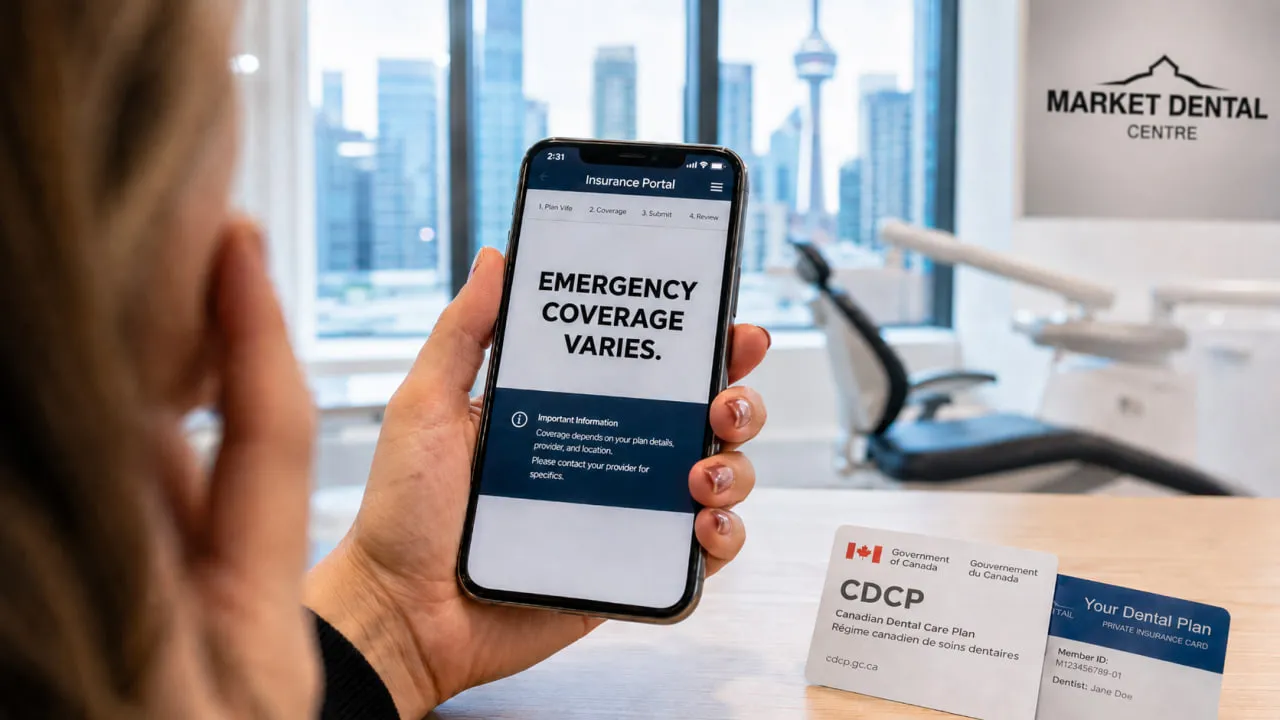
Emergency dental insurance can feel like one more problem to solve when you are already dealing with pain, swelling, or a broken tooth. In Toronto, private dental benefits may help with an urgent exam, X-rays, an extraction, or root canal treatment, but what gets reimbursed depends on your specific plan. CDCP follows different federal rules, while OHIP usually does not pay for routine treatment in a dental office. This guide explains what may be covered, what can still come out of pocket, how direct billing works, and what to ask before treatment so you can make a clearer decision without trying to decode your benefits while you are hurting.
How Emergency Dental Insurance Works in Ontario

Dental coverage for emergencies is not one standard product. In most cases, it means using the dental plan you already have when an urgent problem comes up.
That is why two people insured by the same company can receive very different reimbursement. Their employers may have chosen different deductibles, annual maximums, coverage percentages, frequency limits, and authorization rules.
If you are looking at your benefits while you are in pain, that uncertainty can be frustrating. You do not need to understand the whole policy before calling a dentist. Start with two questions: what care do you need, and what will your plan reimburse toward it?
Your private coverage may depend on:
- The type of dental examination
- Whether X-rays are needed
- The procedure performed
- Your deductible
- Your co-insurance or patient share
- Your remaining annual maximum
- Exam or X-ray frequency limits
- Preauthorization requirements
- The fee amount recognized by your insurer
- Any exclusions or waiting periods
Market Dental Centre's dental insurance information explains common insurance terms and payment questions in more detail.
The Emergency Exam and X-Rays
An urgent visit usually starts with an examination. The dentist first needs to identify why the tooth hurts, why the gum is swollen, or what was damaged in an injury.
X-rays may also be needed to investigate infection, a fracture, a root problem, or a tooth that may need extraction or endodontic treatment.
Many private plans include diagnostic benefits. That does not mean every urgent exam or X-ray is automatically reimbursed. Frequency limits, deductibles, and plan-specific rules can still affect the claim.
Treatment Is a Separate Coverage Question
The exam tells the dentist what is happening. The next step may be a temporary restoration, a filling, drainage, root canal treatment, extraction, or another procedure.
Each service can have its own insurance category and reimbursement rules.
That distinction is important: an emergency can be clinically urgent even when the insurance plan pays only part of the treatment.
CDCP vs Private Insurance for Emergency Dental Care in Ontario

When people compare emergency dental insurance with the Canadian Dental Care Plan, they are comparing two different systems.
Private insurance follows the contract selected by an employer, association, or individual policyholder. CDCP is a federal dental benefit with defined eligibility rules, covered service categories, established fees, and income-based co-payments.
The Government of Canada's current CDCP coverage information lists emergency examinations, X-rays, temporary and permanent fillings, root canal treatment, procedures to reduce infection or pain, and eligible oral surgery among services that may be covered when program criteria are met.
CDCP Co-Payments
CDCP co-payments are based on adjusted family net income:
A 0% co-payment does not mean every possible dental charge is automatically $0. A patient may still be responsible for treatment that is not covered, falls outside program limits, or requires approval that has not been granted.
For eligible CDCP-covered services, Market Dental Centre follows the CDCP-established fee schedule without adding a separate clinic markup above that established amount. Required co-payments and charges for non-covered services can still apply.
You can also review Market Dental Centre's guide comparing CDCP and private dental insurance in Ontario.
Can You Have Private Dental Insurance and CDCP?
Generally, CDCP requires that you do not have access to private dental insurance or coverage.
That can include coverage through your employer, a spouse or family member, a pension, a professional or student organization, an individual policy, or a Health Spending Account that covers dental costs.
This matters locally, where a worker may have employer benefits and a student may already have coverage through a school or student association. Access to that coverage can affect CDCP eligibility even if it is rarely used.
Government social dental programs are different and may coordinate with CDCP.
Does OHIP Cover Emergency Dental Care in Toronto?

For most dental-office emergencies, no.
OHIP generally does not pay for an emergency dental exam, an ordinary filling, routine extraction, or root canal treatment performed in a dental office simply because the tooth is painful.
Some medically necessary dental surgeries performed in hospital can be insured in specific circumstances, including certain fracture repairs, reconstructive procedures, and medically necessary tooth removal.
For an isolated toothache, broken restoration, or painful tooth, a dentist is usually the right place for definitive dental treatment.
A hospital emergency department is more appropriate if you have:
- Difficulty breathing
- Difficulty swallowing
- Rapidly spreading facial or neck swelling
- Uncontrolled bleeding
- Major facial trauma
- Serious general illness along with the dental problem
If those red flags are present, do not wait for an insurance answer before seeking urgent medical care.
Common Emergency Procedures and How Coverage May Work

Emergency dental insurance is often easier to understand when you look at the actual procedures rather than the word "emergency."
Toothache or Dental Infection
A toothache can have several causes, and antibiotics are not automatically the answer.
Depending on the diagnosis, care may involve a filling, drainage, root canal therapy, extraction, or another treatment. If medication is prescribed, the pharmacy cost may fall under a drug benefit rather than the dental portion of your plan.
Chipped or Broken Tooth
A small chip may need smoothing or bonding. A larger fracture may need a filling, crown, root canal treatment, or another restorative approach.
Those procedures can be reimbursed differently under private plans.
The useful question is not simply, "Is a broken tooth covered?" It is, "How does my plan classify the treatment this tooth actually needs?"
Lost Filling or Crown
A lost crown may be suitable for re-cementation, or it may need to be replaced. A missing filling may need a temporary or permanent restoration.
Insurance treatment varies, so do not assume repair and replacement fall under the same benefit category.
Emergency Tooth Extraction
Private plans often include extraction benefits under oral surgery, but the amount reimbursed can depend on complexity, deductible, co-insurance, remaining annual benefits, and the insurer's recognized fee.
Market Dental Centre provides oral surgery and tooth extraction care.
Root Canal Emergency Care
A tooth with severely inflamed or infected pulp may need urgent pulpal treatment or root canal therapy. Some cases are stabilized first and completed later.
Private coverage varies by contract. Under CDCP, eligible root canal treatment and pulpectomies can be covered, while some services, including certain retreatments, require preauthorization.
Market Dental Centre's root canal therapy page explains the clinical treatment in more detail.
What Could You Still Pay With Emergency Dental Insurance?

Even when coverage applies, a patient can still have an out-of-pocket portion.
That can be hard to hear when you are already worried about the tooth and the bill. Having pain is stressful enough; wondering whether the next step will fit your budget can make the situation feel much heavier.
When circumstances allow, ask for the known fees before treatment begins. A few clear numbers are usually more helpful than trying to guess from your insurance card.
Deductible
A deductible is an amount you may need to pay before reimbursement applies to certain benefits.
Not every plan has one, and it may not apply to every service.
Co-Insurance
Co-insurance is the share of an eligible fee that remains the patient's responsibility.
For example, if a hypothetical plan reimburses 80% of its recognized fee, the patient may be responsible for the remaining 20%, plus any other applicable difference.
The 80% figure is only an example. Private plans vary widely.
Annual Maximum
Many private dental plans cap the amount they reimburse during a benefit year.
If you have already used much of that maximum on previous care, there may be less available when an emergency happens.
Recognized Fee
The fee charged by a dental office and the fee recognized by an insurer are not always identical.
An insurer may calculate reimbursement using a particular provincial fee guide year or another amount specified in the contract. Depending on the plan, the difference can become part of the patient's balance.
Frequency Limits
Plans may limit how often some examinations or X-rays are reimbursed.
A new X-ray can still be clinically necessary even when the insurance policy will not reimburse it because of a frequency rule. Clinical need and insurance reimbursement are separate decisions.
Predetermination, Preauthorization, and Urgent Care

A predetermination is an estimate of what an insurer expects to reimburse for proposed treatment. It can be helpful when the next stage of care is expensive and can safely wait for an insurance response.
It is not the same as a guarantee of final payment.
Preauthorization may also be required for certain services under some private plans or CDCP rules.
When someone is in severe pain or has swelling, bleeding, or trauma, the first priority may be getting the problem assessed. Insurance paperwork should not determine whether a clinically urgent condition deserves attention.
Example: Private Coverage During a Toronto Workday
Imagine an office worker near St. Lawrence Market who develops severe molar pain during the afternoon.
Their plan includes diagnostic and endodontic benefits, but a deductible remains and part of the annual maximum has already been used.
The dentist performs an emergency exam and X-ray, then recommends urgent pulpal treatment. Each service is submitted according to the plan. The insurer applies its rules, and the patient remains responsible for the amount not reimbursed.
The point is not the exact percentage. It is that several plan rules can affect one emergency dental cost in Toronto.
Example: CDCP Coverage
Now consider a Toronto patient with active CDCP coverage and adjusted family net income of $75,000.
That income falls in the 40% co-payment tier. For an eligible service provided at Market Dental Centre using the CDCP-established fee, the patient would generally be responsible for the 40% co-payment.
Other costs may still apply if a service is outside CDCP coverage or benefit rules.
How Direct Billing Works With Emergency Dental Insurance
Direct billing can reduce paperwork at an already stressful appointment, but it does not decide whether a claim is covered.
A typical process looks like this:
- You provide your current insurance information.
- The dental office records the details needed for the claim.
- The dentist assesses the problem.
- The office explains the proposed treatment and fees.
- Eligible claim information may be submitted to the insurer.
- The insurer adjudicates the claim under your plan.
- You remain responsible for any amount the insurer does not pay.
That last step is easy to miss. Direct billing is a way to submit a claim; it is not a promise that the plan will pay 100%.
If direct claim submission matters to you, ask Market Dental Centre's Canadian Dental Care Plan information.
What to Bring to an Emergency Dental Appointment
When you are dealing with pain, finding paperwork can feel like one task too many. Bring what you can, but do not delay urgent medical or dental care just because a document is missing.
Useful information may include:
- Your private insurance details or CDCP member information
- Photo ID if requested
- A list of medications
- Relevant medical information
- A short description of when the problem started
- Previous dental X-rays, if they are easy to access and relevant
- A payment method for any patient portion
If the problem followed an injury, tell the clinic what happened when you call.
Why Market Dental Centre Is Convenient for Downtown Toronto Patients
Market Dental Centre provides emergency dental care at 149 Lower Jarvis Street in Downtown Toronto, Ontario, Canada, near St. Lawrence Market and Old Town Toronto.
Its central location can be practical for people who live nearby, work in Downtown Toronto, or study in the surrounding area. A dental emergency does not always happen when you are at home. It may start during a workday, between classes, or while you are already in the city.
If you are searching for an "emergency dentist near me" in central Toronto, location is only one part of the decision. You also need to know whether the clinic can assess the problem, what the initial visit may cost, and what insurance or CDCP information you should bring.
For private benefits, the individual insurer decides reimbursement. For eligible CDCP-covered services, Market Dental Centre follows the CDCP-established fee schedule without a separate clinic markup above that amount.
That distinction keeps the financial conversation clearer: the dental team determines what treatment is appropriate; the insurer or benefit program determines what it will reimburse.
Key Takeaways
Emergency dental insurance can help with the cost of urgent dental care, but it rarely answers every financial question on its own.
- Private coverage varies by contract, even when two people use the same insurer.
- Emergency exams and X-rays may be reimbursed, but deductibles and frequency limits can apply.
- Root canal treatment, extractions, and restorative care may have different benefit rules.
- CDCP is a federal benefit, not private insurance, and uses income-based co-payments and program-specific coverage rules.
- OHIP generally does not cover routine emergency treatment in a dental office.
- Direct billing simplifies claim submission but does not guarantee payment.
- If cost is worrying you, ask what the first visit involves, what fees are known, and what information is needed for the claim.
Need Help With Emergency Dental Insurance and Urgent Care in Downtown Toronto?
A dental emergency is stressful enough without trying to make sense of an insurance policy while you are in pain.
If you need urgent dental care nearby, contact Market Dental Centre and explain what is happening. Let the team know whether you have private benefits or CDCP, ask about current appointment availability, and request the expected fee for the initial assessment when available.
Market Dental Centre is located at 149 Lower Jarvis Street, Toronto, Ontario, near St. Lawrence Market. The location can be convenient if you live nearby, work downtown, or study in the surrounding area.
Call (416) 363-4115 or request an appointment online to discuss the next step.

.webp)


