










If you live, work, or study in Toronto, Ontario, comparing CDCP vs private dental insurance can get confusing fast. Both can reduce dental costs, but they follow very different rules. CDCP eligibility depends on income and having no access to private dental coverage. Private plans depend on the contract chosen by your employer, association, or insurer.
So the useful question is not simply, “Which plan is better?” It is, “What am I eligible for, what will my plan recognize, and what could still come out of pocket?” This guide answers those questions with a practical Ontario and Downtown Toronto perspective.
Confused about your coverage? Market Dental Centre can help you understand the treatment estimate and paperwork connected with your dental care.
What Is the Canadian Dental Care Plan (CDCP)?
The Canadian Dental Care Plan is a federal dental benefit for eligible Canadian residents who do not have access to private dental insurance or coverage. Sun Life administers CDCP claims on behalf of the federal government.
For the 2026–2027 benefit period, you must:
- Have no access to private dental insurance or coverage
- Have an adjusted family net income below $90,000
- Be a Canadian resident for tax purposes
- Have filed the required Canadian tax return for the previous year, along with your spouse or common-law partner if applicable
The first rule is broader than many people expect. Coverage available through your job, pension, spouse, family member, professional or student organization, individual policy, or a Health Spending Account that covers dental costs can make you ineligible.
If your employer offers dental benefits and you choose not to enrol that usually does not make you eligible for CDCP. The government looks at whether the coverage was available to you.
A limited exception applies to certain retirees who permanently opted out of pension dental coverage before December 11, 2023, and cannot opt back in. Coverage through some federal, provincial, or territorial social dental programs is different and may coordinate with CDCP.
Applications are open for the 2026–2027 benefit year. Members should confirm that their coverage is active before each appointment.
For current rules, check the Government of Canada’s CDCP guidance.
What Is Private Dental Insurance?
Private dental insurance may come through an employer, pension, association, or an individual policy you buy yourself.
Sun Life, Manulife, Canada Life, and Blue Cross organizations are among the major carriers in Canada. But the insurer’s name does not tell you how generous your benefits are. Two people can both have a Sun Life plan and still have different reimbursement percentages, deductibles, annual maximums, and exclusions because their employers chose different contracts.
Private plans commonly separate services into categories such as:
- Preventive or basic care
- Major restorative care
- Orthodontics
- Limited or excluded services
A plan might cover exams and cleanings generously, then pay a smaller share of crowns or dentures. An individual policy may also have waiting periods or tighter annual limits.
That is why “80% basic” or “50% major” should be treated as examples, not promises. Your benefit booklet or written treatment estimate is what counts.
Market Dental Centre also notes that private dental coverage varies significantly between individual and employer policies and that patients remain responsible for fees their plan does not pay.
Dental Coverage for Toronto Workers, Residents and Students
In Toronto, the kind of coverage you have often depends on where you work or study.
Many people working in Downtown Toronto receive employer dental benefits. These plans commonly include routine examinations and cleanings, but the details vary. A student may also have dental coverage through a university or student association. Under CDCP rules, access to that student plan can affect eligibility even if the student rarely uses it.
The same applies to coverage available through a spouse or family member.
People who are self-employed, retired, new to Canada, or working without dental benefits may have a different path. If there is genuinely no access to private dental coverage and the income, tax, and residency requirements are met, CDCP may be available.
For patients around St. Lawrence Market and Old Town Toronto, this is worth checking before an appointment. Market Dental Centre is in Downtown Toronto, where residents, office workers, and students often arrive with very different benefit arrangements.
CDCP vs Private Dental Insurance: Detailed Comparison
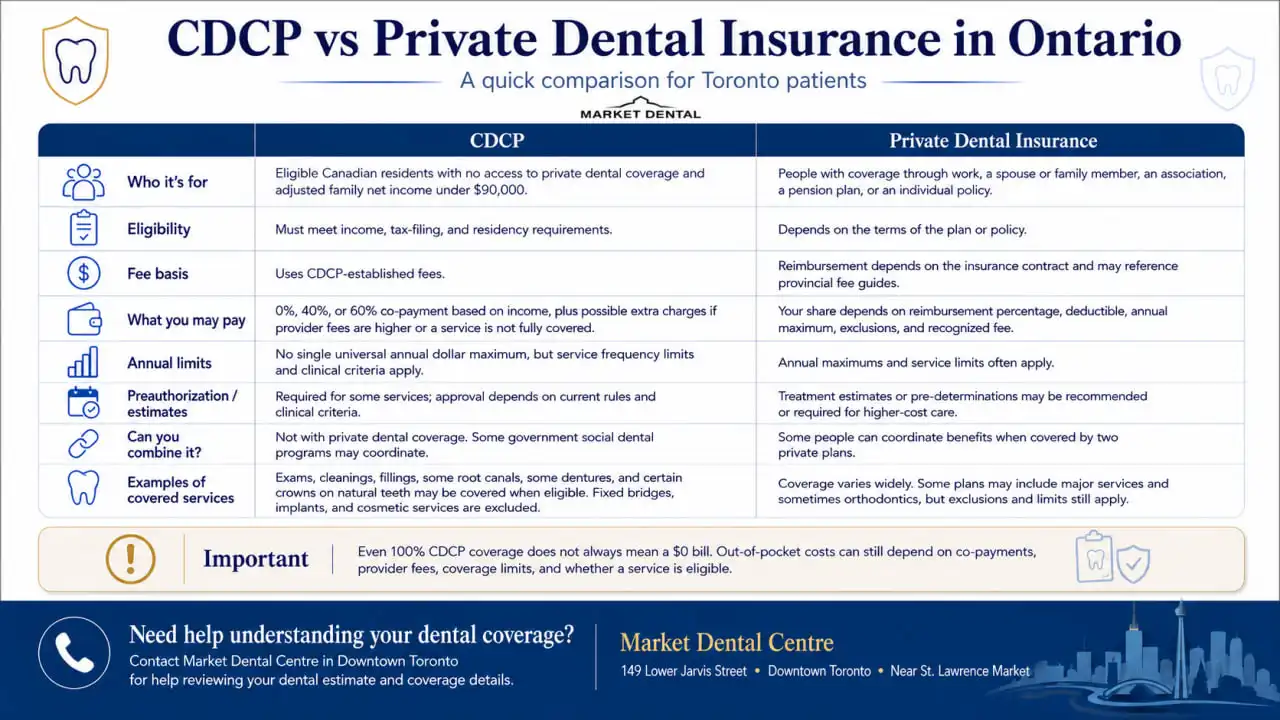
The easiest way to compare CDCP vs private dental insurance is to look at the rules side by side.
Two patients can have the same treatment at the same Toronto dental clinic and still owe very different amounts.
Understanding CDCP Fees, the ODA Suggested Fee Guide and Your Final Bill

This is where many patients get surprised.
The Ontario Dental Association publishes an annual Suggested Fee Guide. It is a reference for dentists and dental plan providers, not a mandatory Ontario price list. Dental practices set their own fees.
CDCP uses its own established fees for covered services. If a provider’s regular fee is higher than the CDCP reimbursement amount, the patient may have an additional balance on top of any income-based co-payment.
That fee difference is a key part of any CDCP vs private dental insurance comparison. “100% coverage” under CDCP means 100% of the CDCP-established fee for an eligible service, not automatically 100% of every dentist’s charge.
How Market Dental Centre Handles Covered CDCP Fees
Market Dental Centre has confirmed that, for eligible CDCP-covered services, the clinic follows the CDCP-established fee schedule rather than adding a separate clinic markup above that amount.
You may still need to pay:
- A 40% or 60% CDCP co-payment based on your adjusted family net income
- Charges for services CDCP does not cover
- Costs related to frequency limits or services that are not approved
- Other treatment you choose outside CDCP benefits
So “no separate markup” does not mean “everything is free.” It means the clinic is not adding another fee above the CDCP-established amount for an eligible covered service.
Ask for an estimate before treatment so you know what applies to your case.
How CDCP Co-Payments Work

Your CDCP co-payment is based on your adjusted family net income.
A quick example helps. Suppose the CDCP-established fee for an eligible service is $100. A patient in the lowest income tier has a 0% co-payment, so CDCP covers the $100. If a clinic normally charges $115, that patient could still owe the $15 difference.
Those numbers are only an example, but the mechanism is real. At Market Dental Centre, the clinic has confirmed that it follows the CDCP-established fee for eligible covered services, so that separate clinic markup does not apply.
Can You Have Both CDCP and Private Dental Insurance?
For most people, no.
CDCP eligibility requires that you do not have access to private dental insurance or coverage. That includes dental coverage through:
- Your employer or pension
- A spouse or family member
- A professional or student organization
- An individual policy
- Supplementary or top-up private dental coverage
- An HSA or HCSA that covers dental expenses
Declining an available workplace plan usually does not solve the issue. If the coverage is available, the federal government normally considers that access.
What Can Be Combined With CDCP?
Some federal, provincial, and territorial social dental programs can coordinate with CDCP. That can apply to eligible Ontario patients already receiving dental support through a government program.
This is different from combining CDCP with a private insurance plan.
What About a Health Spending Account?
Be careful here. If a Health Spending Account gives you access to dental coverage, that access can make you ineligible for CDCP.
So an HSA should not be described as a simple way to top up a CDCP balance. If you are unsure, confirm your situation with Service Canada or your plan administrator first.
Covered Services: CDCP vs Private Dental Insurance
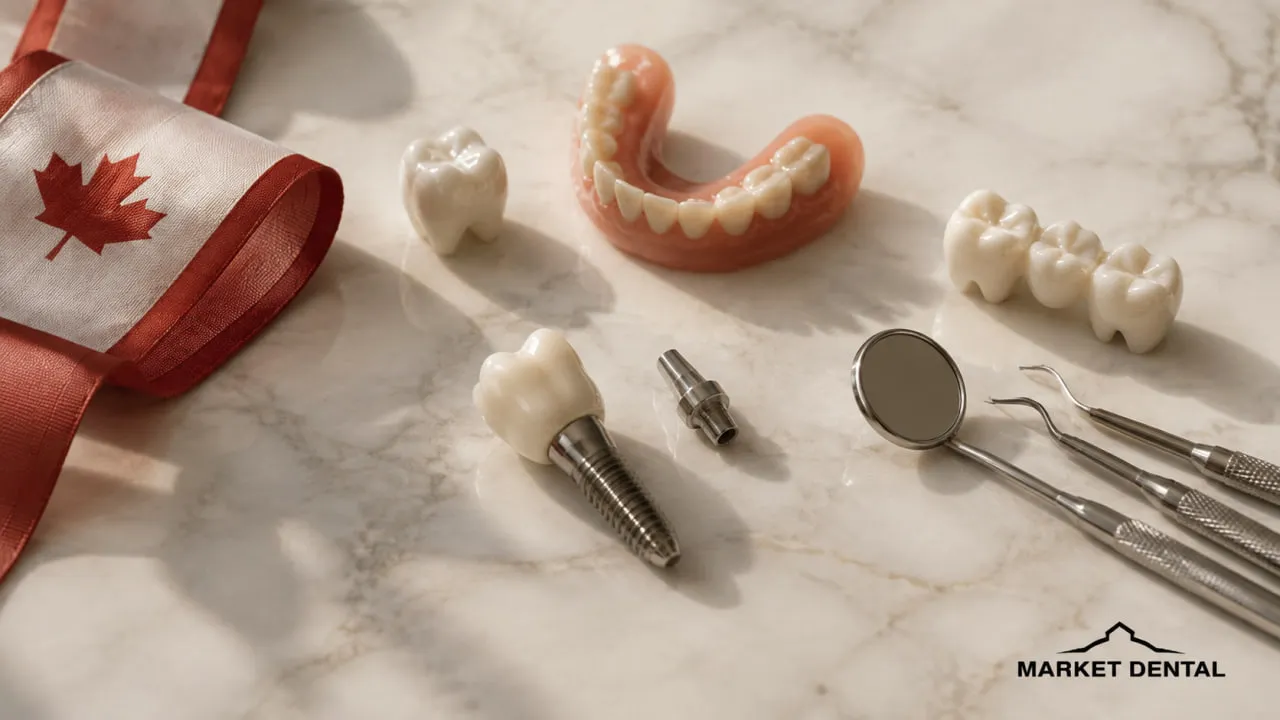
Both systems can help with routine dental care, but the rules are different.
For current service-specific rules, use the official CDCP Dental Benefits Guide.
Root Canal Preauthorization Is More Specific Than It Sounds
Not every root canal needs CDCP preauthorization.
Standard root canal treatment on eligible incisors, canines, bicuspids, first molars, and second molars generally does not require it when clinical criteria are met. Re-treatment, apicoectomy, retrofilling, and standard treatment on third molars do require preauthorization.
Denture Preauthorization Depends on the Type
The same is true for dentures. Some standard complete dentures can be covered without preauthorization, while initial removable partial dentures and certain specialized designs may need approval first.
How Preauthorization Differs From a Private Insurance Estimate

Under CDCP, preauthorization is a formal review for specified services. The dental provider sends the required records, and the request is assessed against CDCP clinical criteria. Approval is not automatic.
Private insurers may use terms such as pre-determination, treatment estimate, or pre-treatment estimate. These show how a proposed service is expected to be reimbursed under your contract.
For higher-cost care, getting the estimate before treatment is usually worth the extra step. It gives you a clearer picture of what the plan may pay and what could remain your responsibility.
Which Option Provides Better Financial Protection?

There is no universal winner, and many people are not actually eligible to choose between both systems.
Scenario A: No Private Coverage and Income Below $90,000
Consider a Toronto retiree with no employer, pension, spouse, or individual dental coverage and an adjusted family net income below $70,000.
If the other requirements are met, CDCP may cover 100% of the established fee for eligible services. Non-covered care can still create an out-of-pocket cost, but routine dental care may become much easier to manage.
Scenario B: Employee With a Workplace Dental Plan
Now consider someone working in Downtown Toronto who has dental insurance through an employer.
That person is generally not eligible for CDCP. The better question is: how much will the existing plan actually reimburse?
Check the remaining annual maximum, deductible, recognized fee, and whether the insurer recommends a treatment estimate. Those details are usually more useful than the percentage printed on a benefits summary.
Scenario C: Self-Employed and Uninsured
A self-employed Toronto resident with no private dental coverage and a family income below $90,000 may qualify for CDCP.
If they are also considering an individual private policy, they should compare premiums, waiting periods, annual limits, expected dental needs, and the effect that buying private coverage would have on future CDCP eligibility.
Private Insurance Annual Maximums and Out-of-Pocket Costs
Many private plans use annual maximums. A common planning range is roughly $1,000 to $2,500 per year, but real plans can be lower, higher, or structured differently.
A policy can also include a deductible, frequency limits, separate orthodontic maximums, laboratory-fee limits, alternate-benefit rules, and excluded services.
For example, a plan may say it reimburses 80% of an eligible treatment, but if only $100 remains in the annual maximum, the insurer may be limited to that $100.
That is why private dental insurance Ontario patients receive through work needs to be read as a full contract, not just a reimbursement percentage.
What Should You Check Before Your Appointment?
You do not need to become an insurance expert. Ask a few practical questions:
- Is my coverage active?
- What is my CDCP co-payment level?
- How much of my private annual maximum remains?
- Is there a deductible?
- Does this service require CDCP preauthorization?
- Should I submit a private insurance treatment estimate?
- Is the treatment excluded or limited?
- What could I still need to pay?
For a CDCP appointment, also confirm that the provider accepts CDCP clients and bills Sun Life directly for covered services.
Choosing Dental Coverage in Downtown Toronto
People looking for dental care in central Toronto often arrive with very different benefit situations.
A professional working in Downtown Toronto may have employer dental benefits. A student may already have a plan through school. A retiree, freelancer, newcomer, or family without private coverage may be exploring CDCP instead.
Market Dental Centre is at 149 Lower Jarvis Street, near St. Lawrence Market and Old Town Toronto. For people who live, work, or study nearby, the location makes it easier to fit routine dental appointments around the rest of the day.
Before booking, work out which category you fall into. Private plan, CDCP, public dental program, or fully out of pocket. Once that is clear, the Fee conversation becomes much simpler.
Why Choose Market Dental Centre for Insurance and CDCP Questions?

Market Dental Centre provides general dental care in Downtown Toronto and can help patients understand the clinic-side information connected with a treatment estimate or claim.
Clear CDCP Fee Information
For eligible CDCP-covered services, Market Dental Centre has confirmed that it follows the CDCP-established fee schedule rather than adding a separate clinic markup above that amount.
Patients may still have a CDCP co-payment or charges for non-covered care, but the clinic’s fee approach removes one source of uncertainty.
Help With Private Dental Benefits
Private plans are less standardized. Market Dental Centre can provide treatment codes, fees, and supporting information needed for an estimate or claim. Your insurer decides eligibility, reimbursement percentage, annual maximums, deductibles, frequency limits, and the final amount paid.
Convenient Downtown Toronto Location
Being near St. Lawrence Market gives patients in Downtown Toronto and Old Town Toronto a central option for routine examinations, preventive care, and other dental services.
For workers and students with busy weekday schedules, choosing a dental office near home, work, or school can also make routine appointments easier to fit into the day.
Key Takeaways
- CDCP eligibility requires no access to private dental insurance or coverage, including an HSA that covers dental costs.
- You generally cannot decline an available employer dental plan simply to qualify for CDCP.
- CDCP co-payments are 0%, 40%, or 60% of CDCP-established fees based on your adjusted family net income.
- A 0% co-payment does not automatically mean every dental bill is $0.
- The ODA Suggested Fee Guide is a reference, not a mandatory Ontario price list.
- Private dental benefits vary by contract, annual maximum, deductible, recognized fee, and exclusions.
- Fixed bridges, dental implants, implant-related procedures, and listed cosmetic services are excluded from current CDCP coverage.
- Market Dental Centre has confirmed that it follows CDCP-established fees for eligible covered services rather than adding a separate clinic markup.
- A useful CDCP vs private dental insurance comparison comes down to eligibility, the treatment you need, and the amount you are likely to pay yourself.
Need Help Understanding Dental Coverage in Toronto?
Still comparing CDCP vs private dental insurance? Start with what affects your next appointment: what coverage do you actually have access to, and what could remain out of pocket?
Market Dental Centre can explain the clinic’s fees and prepare the treatment information you need for a coverage review. Final eligibility and reimbursement decisions remain with CDCP, Sun Life, or your private insurer.
To book an appointment, call us or visit Market Dental Centre at 149 Lower Jarvis Street, Toronto, Ontario, near St. Lawrence Market.

.webp)


