









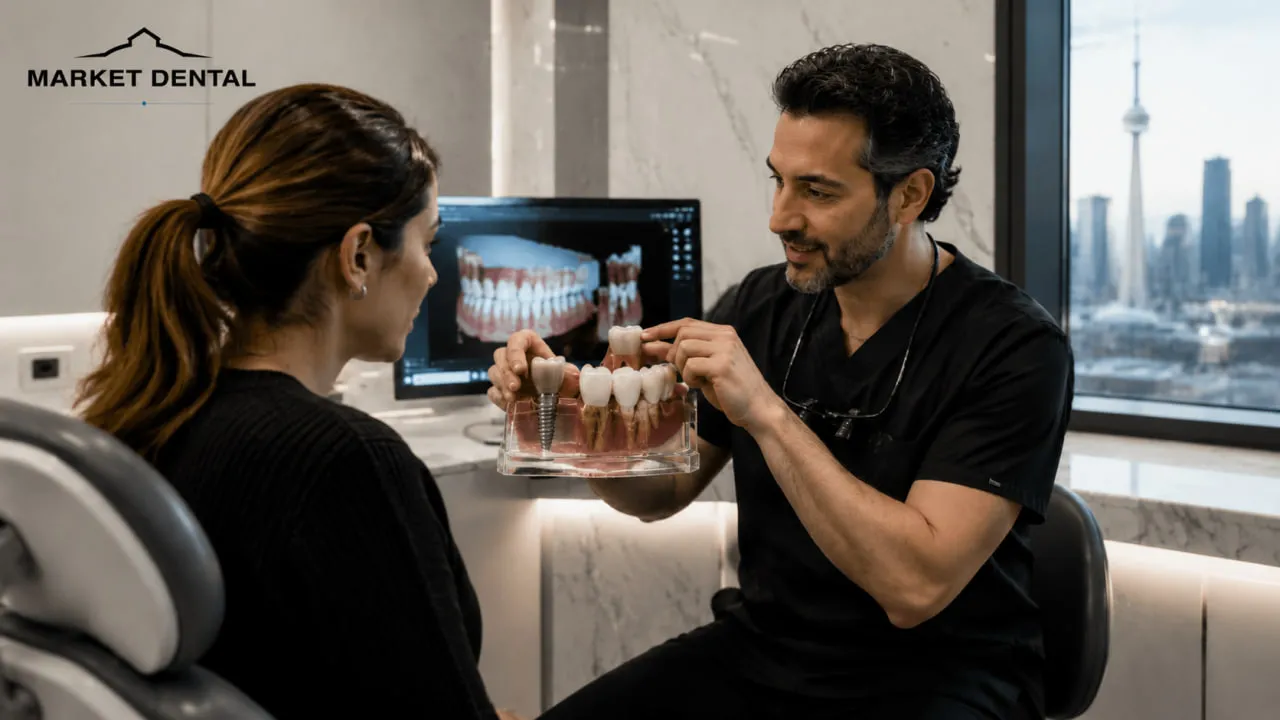
Comparing a dental implant vs bridge usually starts with one practical question: what will hold the replacement tooth in place? Both treatments can replace a missing tooth with a fixed restoration that you do not take out at night, but they get their support in different ways. A dental implant is placed in the jawbone and supports a crown on its own. A conventional bridge relies on the neighboring teeth, which are shaped to hold crowns that carry the replacement tooth between them. That difference affects the bone at the gap, the teeth beside it, treatment time, maintenance, and cost. Neither option is automatically better for every patient, and some people have other reasonable choices.
Dental Implant vs Bridge: The Short Answer
An implant may make particular sense when the teeth beside the gap are healthy, there is enough bone, and your health supports surgery.
A conventional bridge may make particular sense when the neighboring teeth already need crowns or when implant surgery is not appropriate or preferred.
When several teeth are missing, or neither fixed option fits, a partial denture, resin-bonded bridge, or implant-supported bridge may be more appropriate. The best option for a missing tooth depends on the specific gap, not on a general ranking.

What Is a Dental Implant?
A dental implant is a small post, usually titanium, placed in the jawbone where a tooth root used to be. For a single missing tooth, one implant typically supports one crown, and the teeth on either side are not involved in holding it. You can read more about how dental implants are planned and restored at Market Dental Centre.
How an Implant Is Supported
An implant restoration has three parts: the implant in the bone, an abutment that connects it to the visible tooth, and the crown.
Support comes from osseointegration, the biological process in which living bone forms close contact with the implant surface and stabilizes it.
An implant is intended as a long-term tooth replacement, not a guaranteed one. Dental implants have strong long-term evidence when appropriately planned and maintained, but outcomes vary with health, bone, smoking, periodontal condition, maintenance, and other factors.
Main Advantages and Limitations
Advantages:
- Neighboring teeth do not need to be prepared.
- Replacing the root helps preserve bone at the site.
- The implant itself cannot develop tooth decay.
Limitations:
- It requires surgery and a healing period.
- Bone or gum tissue may need to be added first in some cases.
- The tissues around an implant can still become inflamed, so long-term care matters.
- The initial investment can be higher, depending on the case.
What Is a Dental Bridge?
A dental bridge is a fixed restoration that attaches to natural teeth beside a gap. The supporting teeth are called abutments, and the replacement tooth between them is the pontic. Dental bridges are part of the restorative care offered at Market Dental Centre.
Conventional and Resin-Bonded Bridges
A conventional bridge places crowns on the abutment teeth, with the pontic joined between them. A cantilever bridge is supported on one side only.
A resin-bonded bridge, sometimes called a Maryland bridge, bonds a thin wing or framework to the back of a neighboring tooth instead of using full crowns.
Main Advantages and Limitations
Advantages:
- No implant surgery or bone healing phase.
- The overall treatment pathway is often shorter.
- It can incorporate neighboring teeth that already need crowns into the restoration when clinically appropriate.
Limitations:
- It requires removal of tooth structure from the abutment teeth, which cannot be reversed.
- It does not replace the root, so bone at the gap may continue to remodel.
- Cleaning under the pontic takes extra steps.
Dental Implant vs Bridge: Side-by-Side Comparison
The table below summarizes the dental implant vs bridge comparison for a single missing tooth. Individual cases can differ from these general patterns.
What About Appearance?
Neither option is automatically more natural-looking. Both can look natural in suitable cases.
Appearance depends on:
- tooth location;
- gum architecture;
- available bone;
- restorative material;
- smile line;
- pontic design;
- implant position;
- neighboring teeth.
Dental Implant vs Bridge: What Happens to the Bone?
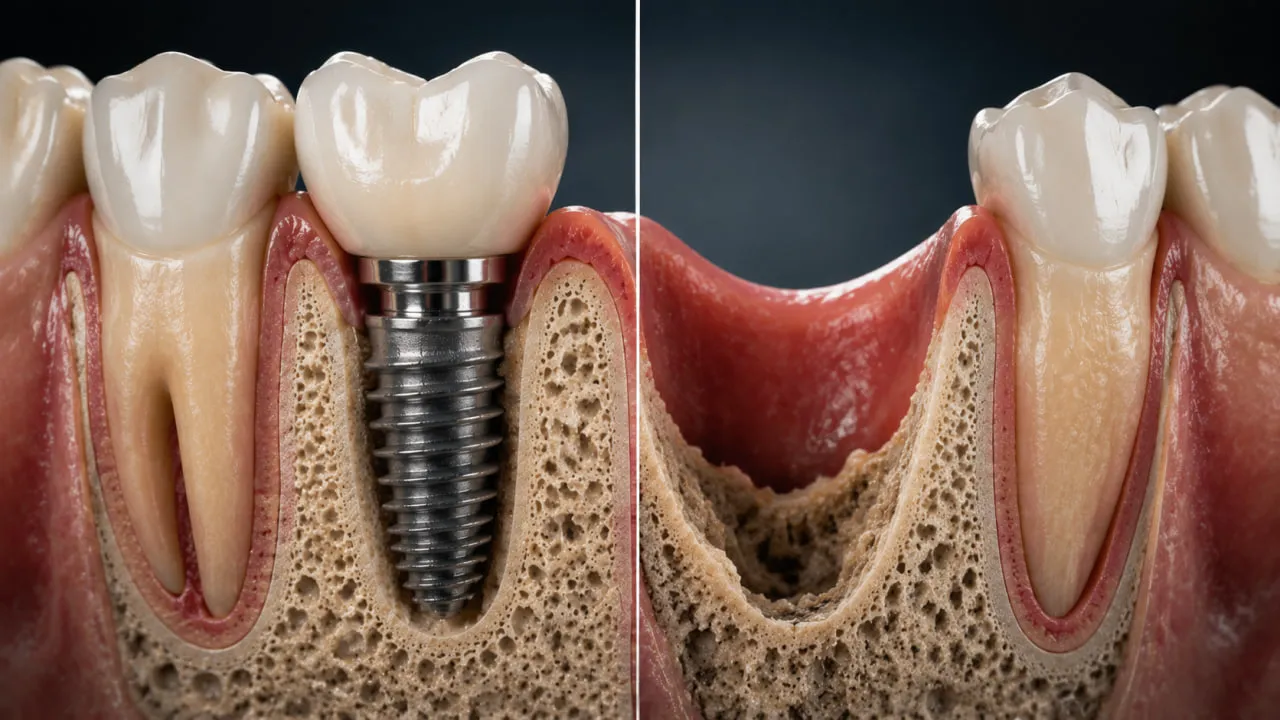
The alveolar bone is the part of the jaw that surrounds and supports the teeth. After a tooth is lost or extracted, that bone remodels because the root is no longer present. The ridge can lose width and height over time, with the amount and rate varying from person to person.
A conventional bridge replaces the visible tooth but not its root. The pontic rests on the gum, and with no root beneath it, bone remodeling at that site may continue. That is the main link between a bridge and bone loss: the bridge does not damage the bone, but it does not replace what was lost.
A dental implant sits in the jaw and, once integrated, transmits functional forces to the surrounding bone. The American Academy of Periodontology notes that because an implant replaces the missing root, bone at the site is generally better preserved than with a tooth-supported bridge. Its page on bone preservation with a single-tooth implant explains this distinction.
Two qualifications matter:
- An implant helps preserve bone; it does not stop all bone change. Bone around implants also remodels and can be lost if inflammation around the implant is not managed.
- An implant itself cannot replace bone that has already been lost. If the ridge has thinned, grafting may be discussed during treatment planning.
Dental implant bone preservation is a meaningful advantage at the missing-tooth site, but it is one factor, not a guarantee.
How Do Implants and Bridges Affect Neighboring Teeth?
For many patients, this is one of the most useful differences in the dental bridge vs implant comparison.
A conventional bridge requires removal of tooth structure from the abutment teeth so crowns can fit over them. This preparation is irreversible, and those teeth will remain restored afterward.
An implant-supported single crown generally does not rely on adjacent teeth for support, which can be a meaningful advantage when those teeth are healthy or minimally restored.
The picture changes when the neighboring teeth already have large fillings, cracks, previous root canal treatment, or another reason they independently need crowns. In that situation, using them as bridge abutments may be clinically reasonable because the planned crowns can also support replacement of the missing tooth.
A practical question is: do the neighboring teeth already need crowns?
If they do, a bridge may deserve serious consideration. If they do not, avoiding irreversible preparation is one reason an implant may be discussed.
What Other Options Can Replace a Missing Tooth?
An implant and a conventional bridge are not always the only reasonable choices for missing tooth replacement.
Resin-Bonded Bridge
A resin-bonded bridge attaches the replacement tooth to a thin wing or framework bonded to the back of one or both neighboring teeth.
It is often more conservative than a conventional bridge because it avoids full crowns. It is commonly considered for selected cases, particularly certain front-tooth spaces.
Suitability depends on the bite, tooth position, available enamel for bonding, and other factors. It is not suited to every missing tooth.
Removable Partial Denture
A partial denture replaces one or several missing teeth and is removable rather than fixed.
It may be useful when several teeth are missing, when fixed treatment is not appropriate, when surgery is not preferred, or when budget or treatment sequencing shapes the plan.
Learn more about partial dentures and how they are fitted.
Implant-Supported Bridge
When several neighboring teeth are missing, implants can sometimes support a bridge spanning more than one missing tooth.
The number and position of implants depend on the anatomy, bite, available bone, and restorative plan.
Leaving the Space Unrestored in Selected Cases
In selected situations, a dentist may determine that monitoring a space is reasonable.
That decision can depend on:
- the location of the gap;
- chewing function;
- the remaining teeth;
- the bite;
- the likelihood of nearby teeth moving;
- oral health;
- patient preferences.
This decision should follow a dental assessment rather than being made based on the appearance of the gap alone.
Who May Be a Candidate for a Dental Implant?
A dentist will typically consider:
- available bone at the planned site;
- gum and periodontal health;
- oral hygiene and the ability to maintain the implant;
- smoking;
- medical history and medications;
- bite forces, including clenching or grinding;
- the location of nearby anatomy, such as nerves and the sinus.
Medical conditions and medications do not automatically rule out implant treatment in every case. They need to be reviewed individually, and coordination with a physician may sometimes be appropriate.
Three-dimensional cone beam CT imaging may also be recommended when clinically indicated.
When Might a Bridge Make More Sense?
A bridge may be reasonable in situations such as:
- the neighboring teeth already require full-coverage restorations;
- implant surgery is not appropriate or not preferred;
- bone augmentation would be needed and is not desired;
- treatment sequencing or timing favors a fixed bridge;
- anatomy or other clinical factors complicate implant placement.
Limited bone alone does not automatically make a bridge the better choice. It may change implant planning, lead to discussion of grafting, or make another option more appropriate depending on the overall case.
What If There Is Not Enough Bone for an Implant?
Not every implant needs a bone graft.
A graft may be considered when available bone is insufficient for the planned implant position or when other clinical factors support it. Our article on dental implant bone graft treatment explains when grafting is used.
If grafting is not appropriate or not preferred, a bridge, partial denture, or another implant plan may be discussed.
Which Usually Takes Longer: an Implant or a Bridge?
A conventional bridge often has a shorter overall treatment pathway because it does not depend on osseointegration.
Implant treatment generally includes a surgical phase and healing before the final crown. Exact timing varies with:
- extraction timing;
- bone condition;
- the need for grafting;
- implant stability;
- healing;
- the restorative workflow;
- laboratory timing.
A temporary tooth replacement may sometimes be possible during treatment, depending on the case.
Which Option Can Last Longer?

Which Option Can Last Longer?
Both options can serve for many years, and both need ongoing care. No universal lifespan applies to either.
An implant restoration has several components. The crown, abutment, screw, or other restorative components may need maintenance, repair, or replacement over time.
A fixed bridge may also function for many years. Its prognosis depends partly on:
- the supporting teeth;
- oral hygiene;
- the bite;
- materials;
- maintenance.
Longevity should not be treated as a guaranteed number when comparing the two treatments.
How Does Maintenance Differ?
An implant needs more than routine brushing. Long-term care includes the implant crown or restoration, gum tissue, surrounding bone, daily plaque control, and professional monitoring.
Our dental implant maintenance page explains what that care involves.
A bridge requires daily interdental cleaning under the pontic, where plaque and food can collect. Depending on the design, options may include floss threaders, interdental brushes, or a water flosser. Your dental team can recommend an approach that suits the restoration.
What Can Happen When a Missing-Tooth Space Is Left Open?

When a gap is not replaced, changes may occur over time, although they do not happen in exactly the same way for every patient.
Possible changes include:
- localized bone remodeling at the site;
- movement or tipping of neighboring teeth;
- movement of the opposing tooth toward the space;
- changes in chewing on that side;
- food trapping or more difficult cleaning.
The significance of these changes depends partly on where the missing tooth is located, the surrounding teeth, and the bite.
Does Insurance or CDCP Cover an Implant, Bridge, or Denture?

What Affects Cost in Toronto?
The cost side of the dental implant vs bridge comparison depends on the case more than the treatment name.
Initial and long-term costs may reflect:
- treatment complexity;
- the number of units being restored;
- grafting;
- restorative materials;
- surgical needs;
- future maintenance;
- possible repairs or replacement;
- insurance coverage.
Toronto patients may receive different estimates for treatments that sound similar because the clinical situations are different.
In Ontario, the Ontario Dental Association publishes a Suggested Fee Guide as a reference. Dentists are not required to charge its suggested amounts.
Private Insurance
Coverage varies by plan.
Differences can include:
- implant exclusions;
- major restorative benefits;
- annual maximums;
- deductibles;
- co-insurance;
- alternate-benefit provisions;
- frequency limits.
A predetermination can help estimate benefits but does not guarantee payment.
Market Dental Centre provides claim and direct-billing support, although direct billing does not determine what your plan covers. See our dental insurance information for more details.
CDCP in 2026
Under the current Canadian Dental Care Plan Dental Benefits Guide, effective April 1, 2026, fixed bridges, dental implants, implant-related procedures, and bone grafts are exclusions.
Some eligible removable dentures, including partial dentures, may be covered subject to program criteria, preauthorization requirements, and frequency limits.
How to Choose Between a Dental Implant, Bridge, or Another Option
A useful way to approach the dental implant vs bridge decision is to work through several questions with your dentist:
- Are the neighboring teeth healthy, or do they already need crowns?
- Is there enough bone, and would grafting be appropriate if more bone is needed?
- Do your health and gum condition support implant surgery and healing?
- How many teeth are missing, and where are they located?
- What treatment timeline and maintenance requirements work for you?
- How do private insurance or CDCP rules affect the available options?
- Is another option, such as a partial denture or resin-bonded bridge, worth considering?
An assessment at Market Dental Centre can help determine which missing-tooth option may be appropriate and whether any part of treatment requires additional planning or referral.
Key Takeaways
- The dental implant vs bridge choice depends on the gap, neighboring teeth, bone, health, and preferences, not on one treatment being universally superior.
- An implant helps preserve bone at the missing-tooth site because it replaces the missing root; a conventional bridge does not.
- A conventional bridge requires irreversible preparation of its abutment teeth, which may be reasonable when those teeth already need crowns.
- An implant usually involves surgery and a healing phase, while a conventional bridge can often be completed through a shorter treatment pathway.
- Both treatments need long-term maintenance, and neither has a guaranteed lifespan.
- Resin-bonded bridges, removable partial dentures, and implant-supported restorations may also be considered in selected cases.
- Private insurance coverage varies, while the current CDCP excludes fixed bridges, implants, implant-related procedures, and bone grafts.
Compare Your Missing-Tooth Options in Downtown Toronto
If you are comparing a dental implant, bridge, partial denture, or another missing-tooth option, an examination can look at the gap, neighboring teeth, gums, bone, bite, health history, and treatment preferences.
Market Dental Centre is located at 149 Lower Jarvis Street in Downtown Toronto, near St. Lawrence Market.
Call (416) 363-4115 or request an appointment online.

.webp)


