









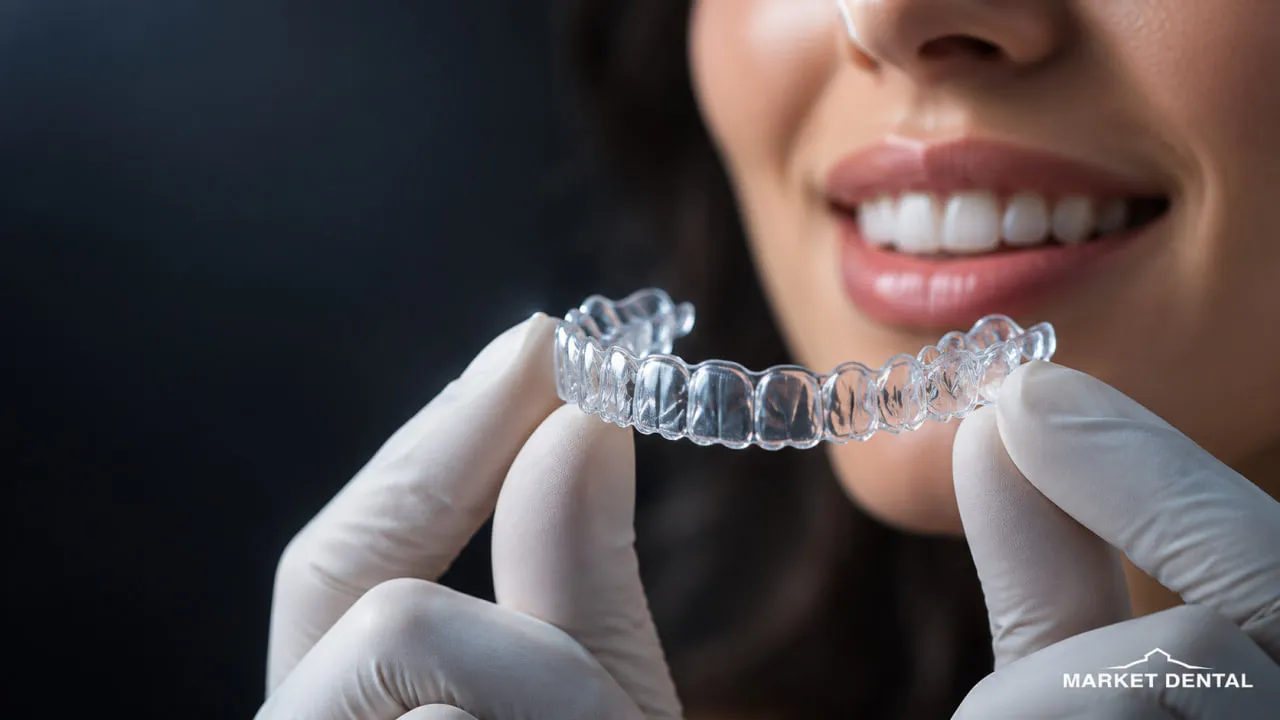
How does Invisalign work when each aligner is just a thin, removable shell with no brackets or wires? The aligner provides the force, but your own supporting tissues make tooth movement possible. Each tray is shaped slightly ahead of your current tooth position. When it fits over your teeth, it applies controlled pressure to selected areas. That force reaches the periodontal ligament and bone around the roots, where gradual remodeling allows teeth to shift. Understanding how Invisalign moves teeth also explains why consistent wear, carefully staged treatment, attachments in some cases, and retention after treatment all matter.
How Does Invisalign Work? The Short Answer
Invisalign uses a sequence of custom clear aligners. Each aligner represents a small step between where your teeth are now and where the treatment plan intends them to move.
When an aligner fits over teeth that have not yet reached that next position, the material flexes and applies force to selected teeth.
That force passes through the periodontal ligament, the thin living tissue between each tooth root and the surrounding bone. The supporting tissues gradually adapt, allowing the tooth to change position before the next stage begins.
The aligner supplies the mechanical force. Your tissues create the biological response that makes movement possible.
You can also see how Invisalign clear aligners are used as a treatment option at Market Dental Centre.
What Happens Around the Tooth When an Aligner Applies Force?

A tooth root is not fused directly to your jawbone. It sits inside a socket and is connected to the surrounding alveolar bone through the periodontal ligament, often shortened to PDL.
This tissue contains fibers, blood vessels, nerves, and cells involved in maintaining the bone around the tooth.
So how does Invisalign work at the biological level? In the same basic way other orthodontic appliances move teeth: controlled force changes the environment around the root, and the supporting tissues respond over time.
The Periodontal Ligament Responds to Orthodontic Force
The periodontal ligament acts as a flexible connection between the tooth and its socket.
When an aligner moves a tooth slightly away from its resting position, some areas of the ligament experience compression while others experience tension.
That mechanical change affects cellular signaling and blood flow within the supporting tissues. Those signals help coordinate the remodeling that allows the tooth to move.
The response is gradual. It is not simply a matter of physically pushing a tooth through solid bone.
Bone Remodeling Makes Tooth Movement Possible
Bone is living tissue that is continually renewed.
Two types of cells are especially important during orthodontic tooth movement:
- Osteoclasts participate in removing bone where space needs to be created for a moving root.
- Osteoblasts participate in forming bone as the tissues adapt around the tooth's new position.
The familiar "pressure side" and "tension side" explanation is useful, but it is simplified. Tooth roots are three-dimensional, and many orthodontic movements involve combinations of tipping, rotation, translation, intrusion, or root movement.
Biology also takes time. Switching to the next aligner early simply because the current tray feels less tight does not mean the supporting tissues are ready for the next stage.
How Does the Plastic Aligner Actually Move a Tooth?
Each aligner is manufactured to represent a slightly advanced stage of the treatment plan.
When you place that aligner over teeth that have not yet reached the programmed position, the material flexes. As it tries to conform to its intended shape, it applies force to selected tooth surfaces.
The effect of that force depends on several factors:
- where the aligner contacts the tooth
- the direction of the force
- the shape of the tooth
- the position of the root
- the movement being attempted
- whether attachments or other features are used
Moving the visible crown of a tooth is not mechanically identical to moving its root. Rotating a rounded tooth is also different from tipping a relatively flat tooth.
That is why a clear aligner treatment plan involves more than making a series of progressively straighter trays.
What Does SmartTrack Material Do?
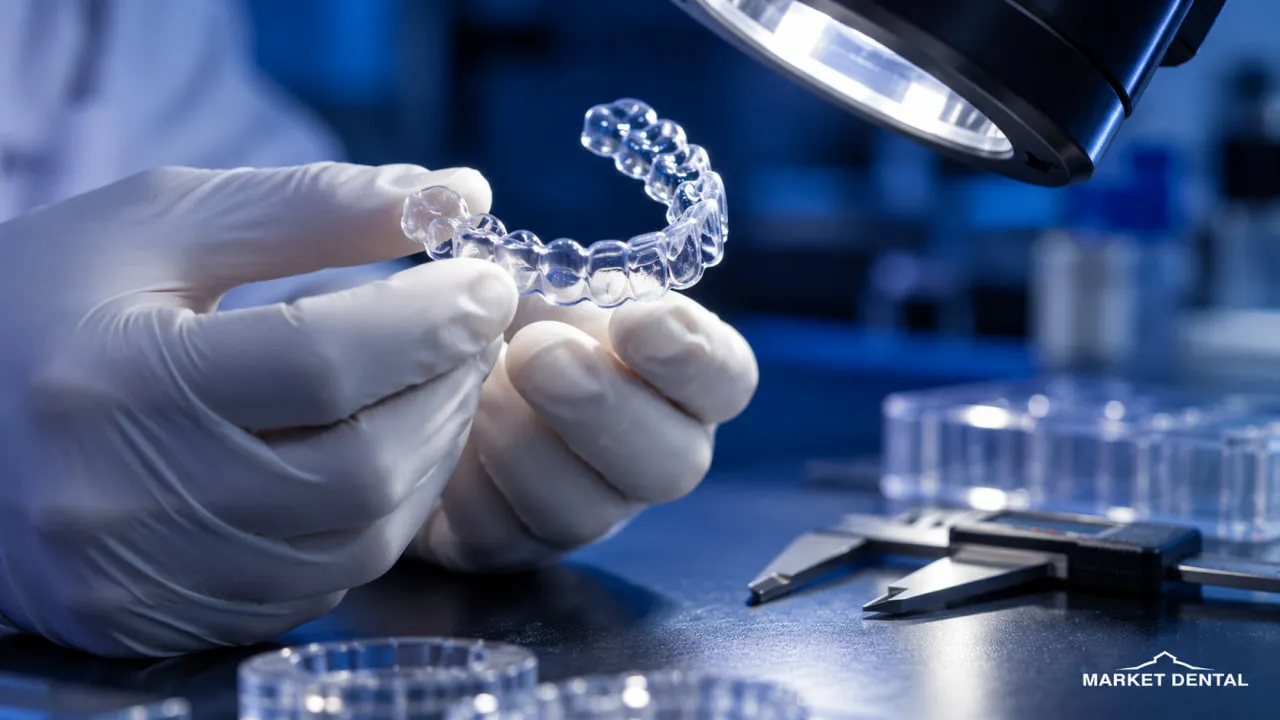
Invisalign aligners are made from SmartTrack, Align Technology's proprietary aligner material.
The material needs enough flexibility to fit over teeth that have not yet reached the next planned position while maintaining contact with the surfaces being used to apply force.
Align describes SmartTrack as being designed to provide gentle, sustained force. It is still only one part of treatment.
Tooth movement also depends on:
- treatment planning
- aligner shape
- attachments where needed
- the sequence of movements
- wear consistency
- individual biology
SmartTrack itself does not guarantee that every programmed movement will occur exactly as shown in a digital plan.
Why Are Invisalign Attachments Needed on Some Teeth?
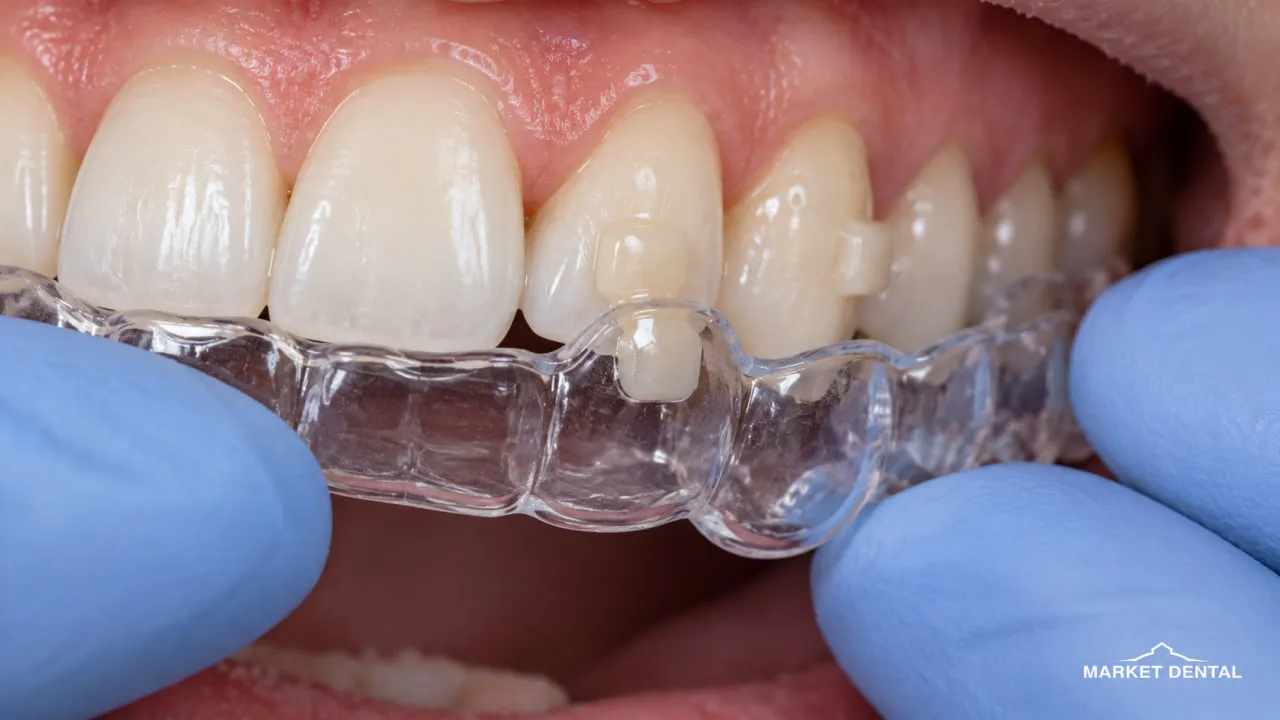
Attachments are small, tooth-colored composite shapes bonded temporarily to selected teeth. Matching spaces in the aligner fit around them.
So how does Invisalign work when a smooth or rounded tooth needs a movement the plastic alone cannot control well?
Attachments give the aligner an additional surface to engage. This can change where force is applied and the direction in which it acts.
Depending on the treatment plan, attachments may help with:
- rotation
- extrusion
- intrusion
- root control
- anchorage
- other more controlled movements
Not every Invisalign patient needs attachments.
Their number, position, and shape depend on the movements being planned. Align uses the SmartForce name for certain Invisalign attachment features, but not every composite attachment should automatically be described as SmartForce.
Attachments are temporary and are removed when they are no longer needed. The dentist carefully removes the composite and finishes the tooth surface afterward.
Why Does Invisalign Wear Time Matter So Much?

Wear time is one part of how does Invisalign work that depends heavily on the patient.
Invisalign patients are commonly instructed to wear their aligners for about 20 to 22 hours per day, according to the treatment plan.
An aligner can only apply its planned force while it is seated properly over the teeth.
If trays remain out longer than prescribed:
- teeth may not reach the programmed position for that stage
- the next aligner may not seat fully
- the treatment sequence can become less accurate
- additional monitoring or adjustments may be needed
There is no precise number of hours after which teeth suddenly "relapse." The bigger issue is repeated inconsistency.
Imagine someone working in Toronto's Financial District who removes aligners for breakfast, a long client lunch, several coffees, and dinner. None of those breaks feels excessive on its own, but together they can reduce daily wear substantially.
If a tray is no longer seating as expected, do not automatically move on to the next one. Contact the treating dental provider for instructions.
How Digital Treatment Planning Stages Invisalign Tooth Movement
The trays themselves are only part of how does Invisalign work. Much of the treatment is planned before the first aligner is manufactured.
A typical planning sequence may include:
- Examination of the teeth, gums, and bite
- Dental records, photographs, and imaging as appropriate
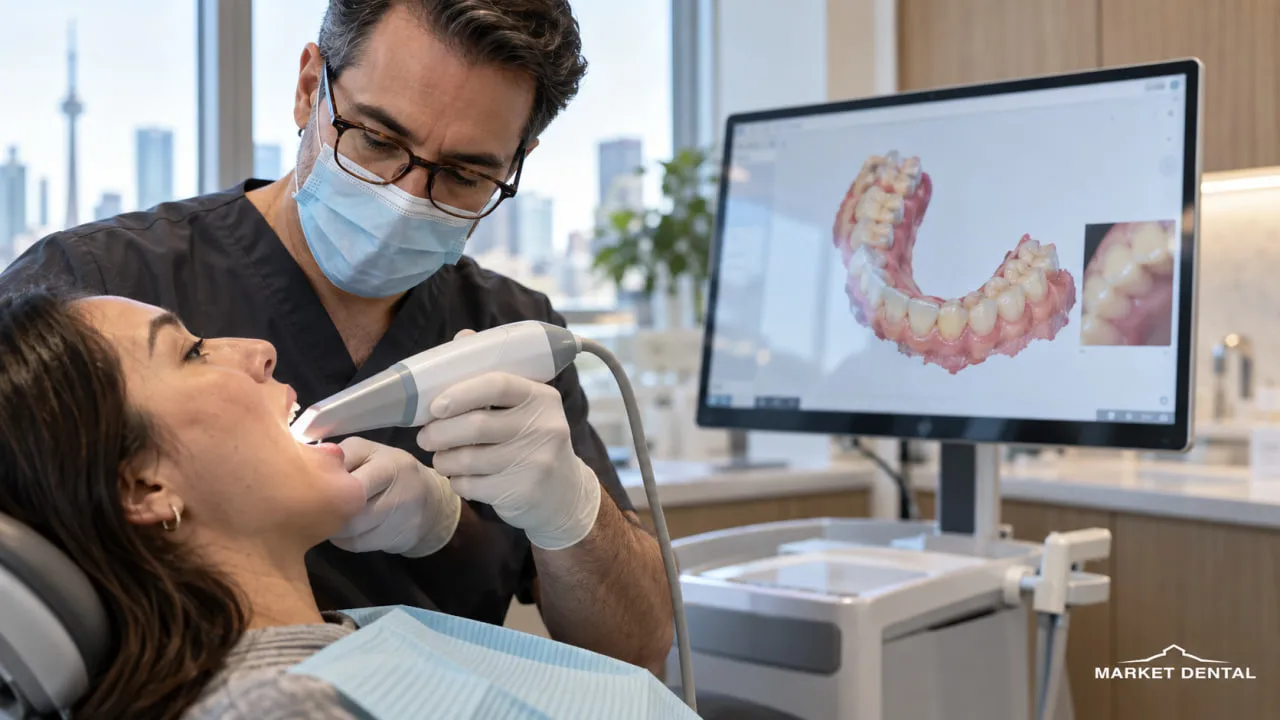
- A digital scan or impression
- Creation of a digital model
- ClinCheck treatment planning
- Staging tooth movements into a sequence
- Manufacturing the aligners
- Monitoring progress and making refinements when necessary
From Dental Records to a Digital Treatment Plan
Invisalign treatment uses dental records to build a digital model of the teeth and bite.
Invisalign's official treatment process describes a workflow using iTero digital scanning, while some providers may use other accepted records or impression methods.
That describes the Invisalign system generally. It should not be taken to mean that every dental office uses the same scanner or workflow.
What ClinCheck Does
ClinCheck is Invisalign's treatment-planning software.
It allows the treating provider to review planned tooth positions, sequence movements, assess staging, and plan features such as attachments before the aligners are produced.
The animation should be understood as a treatment plan, not a guaranteed preview of the final clinical result.
Actual tooth movement can differ from programmed movement. That is one reason progress checks, revised plans, and additional aligners may sometimes be needed.
Why Might Space Need to Be Created Between Teeth?
Crowded teeth need space before they can be aligned.
Sometimes space can be created by changing tooth positions. In selected cases, a dentist may recommend interproximal reduction, commonly called IPR.
IPR involves carefully removing a small amount of enamel between selected teeth. It may be used to create room for alignment or improve contact relationships between neighboring teeth.
Not every Invisalign patient needs IPR, and the amount is determined individually.
What Types of Tooth Movement Can Invisalign Plan?
Clear aligners can be used to plan several types of tooth movement, but planned movement and achieved movement are not always identical.
Research on clear aligner tooth movement has shown that some movements, particularly rotation of certain rounded teeth and some vertical movements, can be less predictable than simpler movements.
Attachments, revised staging, refinements, elastics, or other treatment features may be used when appropriate.
Can Invisalign Work for Complex Crowding or Bite Problems?
Sometimes, but not every orthodontic problem is equally suitable for clear aligners.
So how does Invisalign work when the concern involves the bite as well as individual tooth position? The answer depends on the type of problem and the movements required.
A dentist may consider:
- the type and extent of the malocclusion
- the direction and amount of tooth movement needed
- the relationship between the upper and lower jaws
- gum and bone health
- existing crowns, bridges, implants, or restorations
- whether elastics or other auxiliaries may be needed
- the patient's ability to wear aligners consistently
Some patients may benefit from attachments, elastics, refinements, another orthodontic approach, or specialist assessment.
Our page about malocclusions and bite problems explains common bite concerns in more detail.
How Fast Does Invisalign Move Teeth?
There is no universal rate.
Some clear-aligner protocols stage certain linear movements in small increments, often around 0.20 to 0.25 mm per aligner, but that should not be interpreted as a promise that every tooth physically moves that exact distance with every tray.
The prescribed amount and the amount actually achieved can vary by:
- tooth
- movement type
- treatment stage
- case complexity
- individual biology
- wear consistency
- need for refinements
Visible changes may appear before treatment is complete, but treatment time should be estimated from the individual plan rather than a universal movement rate.
Switching trays early does not make the biological response occur faster.
Why Can a New Invisalign Tray Feel Tight?
A new aligner represents the next planned position, so it may feel tighter when first placed.
Temporary pressure or tenderness can occur as a new stage begins.
That sensation does not prove that treatment is working perfectly, and feeling very little pressure does not necessarily mean that tooth movement has stopped.
Contact the treating provider if discomfort is severe, lasts longer than expected, comes with swelling, or seems related to a sharp or damaged aligner.
If you are also comparing how the two treatments differ in comfort, daily wear, and routine, see our guide to Invisalign vs. metal braces for adults.
Why Do Teeth Need Retention After Invisalign?

Finishing active Invisalign treatment does not mean teeth can never shift again.
Teeth naturally remain capable of movement, and changes can occur after any form of orthodontic treatment.
Retainers help maintain the positions achieved during active treatment.
Options may include:
- removable clear retainers
- fixed retainers bonded behind selected teeth
- other retainer designs recommended for the case
Vivera is an Invisalign-associated clear retainer option, but it is not the only type of retainer.
The appropriate retainer and wear schedule are individualized.
Does Insurance Cover Invisalign in Ontario?
Private orthodontic benefits in Ontario vary considerably between plans.
A policy may include:
- age restrictions
- orthodontic exclusions
- lifetime orthodontic maximums
- co-insurance
- staged reimbursement
- other plan-specific limits
A predetermination may help estimate available benefits, but it does not guarantee payment.
Market Dental Centre can assist with insurance claims and administrative information. Direct billing does not determine whether Invisalign is covered by a patient's plan.
For more information about claims and benefits, see Market Dental Centre's dental insurance guide.
The Canadian Dental Care Plan currently states that orthodontic services are not available under the program, so Invisalign is not currently covered by CDCP.
Key Takeaways
- Aligners provide the force, but living tissues around the roots make tooth movement possible.
- Invisalign moves teeth in planned stages rather than all at once.
- The periodontal ligament and surrounding bone adapt as teeth change position.
- Attachments may give aligners additional surfaces to engage for selected movements.
- Consistent wear, commonly around 20 to 22 hours per day when prescribed, helps keep treatment aligned with the plan.
- ClinCheck shows planned movement rather than guaranteeing the final result.
- Some tooth movements are more difficult to achieve accurately than others.
- Retainers help maintain tooth position after active treatment.
Want to Know Whether Invisalign Can Make the Movements Your Teeth Need?
Understanding how does Invisalign work is useful, but it cannot tell you whether clear aligners are appropriate for your particular bite.
An assessment can look at:
- tooth position
- bite relationship
- gum health
- existing dental work
- movements required
- whether attachments or IPR may be considered
- realistic wear expectations
- retention needs
Market Dental Centre is located at 149 Lower Jarvis Street in Downtown Toronto, near St. Lawrence Market.
Call (416) 363-4115 or request an appointment to discuss whether Invisalign may be appropriate for your treatment needs.

.webp)


